 Object References in Integration Scenarios
In this section you find detailed information on possible object references and how these are treated by the process integration adaptation wizard.
An integration scenario can contain the following types of application components:
Application component based on product version from the SLD (SLD-based)
Application component based on product instance from the SLD (SLD-based)
A product instance represents the smallest to install entity of a product. One the other hand, a product version can be composed of multiple parts that are installed separately.
Template application component
Represents a “black box” application component and can be used in case a corresponding product version or product instance has not been modelled yet in the SLD.
In general, objects referred to in SLD-based application components have to be assigned to a software component version that fits the corresponding product version. Secondly, these software component versions need to be imported into the Integration Repository.
 Note
Note
All related software component versions that belong to a product version or product instance are defined in the SLD. In general, only a subset of software component versions has been imported into the Integration Repository. Within an application component object references are allowed only for target objects that are assigned to a related software component version (with regard to the product version of the application component). Furthermore, the software component version needs to be imported into the Integration Repository.
There are the following types of object references in integration scenarios:
Relative object reference – target object is assigned to the same software component version as source object.
Absolute object reference – target object is assigned to another same software component version than source object.
The following types of object references can occur between the different entities within an integration scenario:
Source Object |
Target Object |
Object Reference Type |
Integration Scenario (SLD-based application component) |
Internal action |
absolute |
Integration Scenario (template application component) |
External action |
relative |
Internal action |
Message interface |
relative |
External action |
Message interface |
absolute |
Integration Scenario (connection) |
Interface mapping |
absolute |
Integration Scenario (connection) |
Channel template |
absolute |
Integration Scenario (SLD-based application component) |
Integration process |
absolute |
Integration Scenario (template application component) |
Integration process |
relative |
The following figure illustrates absolute and relative object references between integration scenario (application component) and action on the one hand and between action and message interface on the other hand.
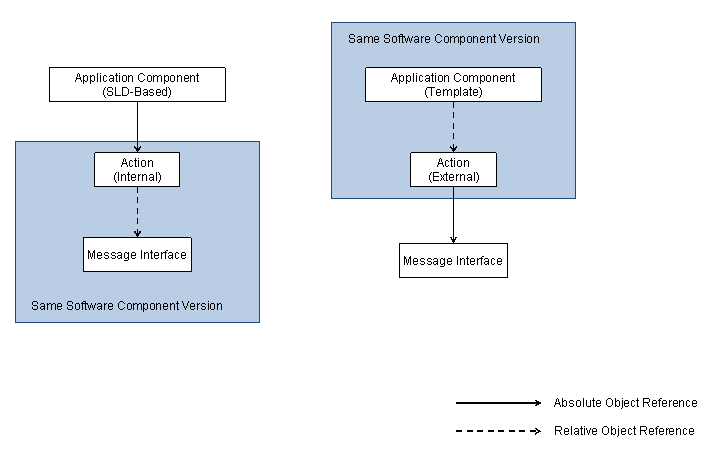
Absolute and Relative Object References
During a release transfer, the product versions of SLD-based application components and absolute object references are not adapted automatically.
To overcome this issue, use the integration scenario adaptation wizard.