
 Collaborative Transportation Planning

Purpose
Collaborative transportation planning allows manufacturers and their transportation service providers (carriers or forwarders, for example) to streamline their work processes and ultimately benefit from reduced handling costs, improved transparency, and greater efficiency.
Manufacturers inform their transportation service providers about scheduling agreements. The transportation service provider can accept, reject, or change the transportation RFQs. For instance, the TSP can suggest an alternative pickup or delivery date.
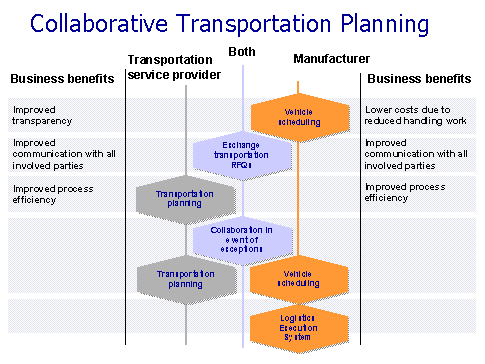
You can use EDI or the Internet for collaborative transportation planning.
Collaborative Transportation Planning with EDI
Prerequisites
● You have defined the partner profiles for an EDI partner of type CR (Tools → Business Communication → IDoc Basis → Administration → Partner profile).
Depending on the scenario, you have maintained message type PLNSHP here for the outbound and inbound parameters.

You can choose any partner number.
For more information, see
 IDoc Interface/Electronic Data
Interchange.
IDoc Interface/Electronic Data
Interchange.
● You have assigned this EDI partner to your transportation service provider.
To do this, access the location master of the transportation service provider with location type 1020 and complete the EDI partner number details on the General tab page.
●
You have created the
VS alert
profile.
●
You have carried out the planning
in the SAP APO
Transportation
Planning and Vehicle Scheduling (TP/VS) component and created planned
shipments.
Process Flow
...
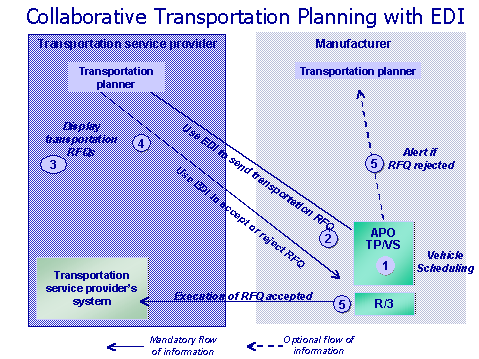
1. The transportation planner at the manufacturer’s plant plans in TP/VS and chooses a transportation service provider either manually or automatically.
2. If this planner releases shipments in TP/VS, the system sends a transportation RFQ to the transportation service provider automatically using EDI (IDOC PLNSHP).
3. The transportation planner at the transportation service provider then uses EDI to accept or reject the transportation RFQ. He or she can also change the pickup or delivery dates and times set out in the transportation RFQ (that is, quote different ones).
4. If the transportation RFQ is rejected or changed, the transportation planner at the manufacturer receives notification through the SAP APO Alert Monitor. If it was rejected, he or she can invite tenders for new shipments or cancel shipment tendering.
5. If the transportation RFQ was accepted, the transportation planner at the manufacturer’s plant can continue planning in TP/VS. Finally, the planned shipments are transferred to the SAP R/3 execution system where they become actual shipments.
Collaborative Transportation Planning with the Internet
Prerequisites
● You have defined collaboration partners for your transportation service providers in the Transportation planning collaboration scenario (Supply Chain Collaboration → Environment → Current Settings → Collaboration Partners).
For more information, see Maintaining Settings for Collaborative Partners.
● You have assigned a collaboration partner to the transportation service provider (in master data).
To do this, access the location master of the transportation service provider with location type 1020 and complete the collaboration partner details on the General tab page.
● You have followed this menu path and entered your e-mail address (on the Address tab page): Tools → Administration → User Maintenance → Users.
●
You have created the
VS alert
profile.
●
You have carried out the planning
in the SAP APO
Transportation
Planning and Vehicle Scheduling (TP/VS) component and created planned
shipments.
Process Flow
...
1. The transportation planner at the manufacturer’s plant plans in TP/VS and chooses a transportation service provider either manually or automatically.
2. If this planner wishes to send e-mails to the transportation service providers, he or she has to select the Sending of E-Mails Activated indicator in the communication settings for the collaboration partner.
The transportation planner can also revoke transportation RFQs. To do this, he or she has to cancel the release of the relevant shipments. In this case, the transportation service providers involved receive a list of revoked transportation RFQs by e-mail.
3. The TSP’s transportation planner reviews the transportation RFQ on the Internet and either accepts or rejects it. If necessary, he or she can change the pickup or delivery dates and times set out in the transportation RFQ (that is, quote different ones). Furthermore, he or she can view an XML file containing all the details of the transportation RFQ by clicking on the shipment number. The XML file can be displayed in a transportation service provider-specific layout that is defined in the APO CLP partner settings.
If you wish to provide your transportation service providers with an XML file, you must select the XML Display Activated indicator in the communication settings for the collaboration partner. You also need to edit the EDI settings.
4. If the transportation planner rejects or modifies the transportation RFQ , the transportation planner at the manufacturer receives notification through the SAP APO Alert Monitor. If the shipment was rejected, he or she can invite tenders for new shipments or cancel shipment tendering.
5. If the transportation RFQ was accepted, the transportation planner at the manufacturer’s plant can continue planning in TP/VS. Finally, the planned shipments are transferred to the SAP R/3 execution system where they become actual shipments.

User Parameters for Collaborative Transportation Planning
Description |
Prerequisite |
You wish to dispatch a shipment. For this purpose, you wish to send the IDoc PLNSHP directly from within TP/VS (/SAPAPO/VS01) instead of through the function Send Planned Shipments through EDI (/SAPAPO/SHPEDI). |
Enter the following data on the Parameters tab page (System → User Defaults → Own Data): Parameter /sapapo/clp_vsidoc, value X |
You wish to prevent the details about planned shipments from being changed on the Internet. |
Enter the following data on the Parameters tab page (System → User Defaults → Own Data): Parameter /sapapo/clp_bidnochg, value X |
You do not want the transportation service provider to have access to the details of the planned shipments. |
Enter the following data on the Parameters tab page (System → User Defaults → Own Data): Parameter /sapapo/clp_bidnodtl, value X |
You do not want to display certain data about the planned shipments on the Internet. |
Enter the following data on the Parameters tab page (System → User Defaults → Own Data): Parameter /sapapo/clp_bidnofld ● Value 'X ' (first character) The Source Location field is not displayed ● Value ' X ' (second character) The Destination Location field is not displayed. ● Value ' X ' (third character) The Planned Pickup Date field is not displayed. ● Value ' X ' (fourth character) The Delivery Date field is not displayed. ● Value ' X ' (fifth character) The Distance field is not displayed. ● Value ' X ' (sixth character) The Total Time field is not displayed. ● Value ' X ' (seventh character) The Journey Time field is not displayed. ● Value ' X' (eighth character) The Vehicle Type field is not displayed.
You can also combine these parameter values. For example, if you wish to prevent the Distance, Journey Time, and Vehicle Type fields from being displayed, enter the value ' X XX'. |