
 Technical System Landscape

The portal platform is one of the building blocks of SAP NetWeaver. In it, other NetWeaver capabilities that run in the portal environment can be integrated, such as:
● Knowledge Management
● Collaboration
● Guided Procedures
Portal Platform
The portal platform is deployed as an application in the Application Server (AS) Java, and consists of the following:
● Portal Framework
The portal framework is a virtual environment that enables the portal as development and runtime environments.
Applications that run in the portal – both out-of-the-box and custom applications, and both business and portal-related applications – are developed with various technologies, most notably, the Portal Runtime and Web Dynpro.
The portal provides a set of services to enable business applications to integrate into the portal, as well as to build applications for running the applications. Such services include the navigation, object-based navigation and PCD services.
The following components, also part of the platform, are required to set up a portal landscape:
● Database: The portal stores data required by the portal at runtime in the same database used by the AS Java.
● User Persistence Store: A storage area containing information about users, such as directory servers. This system works with the mechanism that implements security systems for authentication and authorization: the User Management Engine (UME), an SAPproprietary mechanism that allows access to various content, using Single Sign-On (SSO).
● Java Development Kit (JDK): The Java runtime environment.
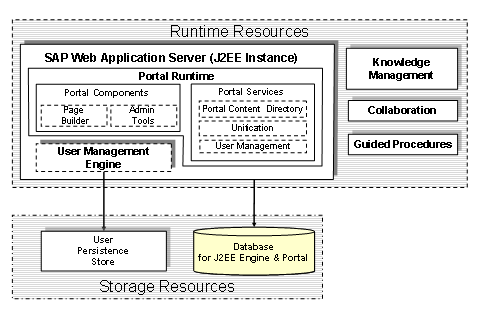
The following figure illustrates the runtime resources of the portal:
Portal Resources at Runtime
Portal resources are of two types:
Runtime resources consist of portal components and services that generate the portal framework, assemble portal pages and iViews, and manage themes and styles. These resources make use of stored data in the database and in the user store.
The portal runtime resources are:
○ Application Server (AS) Java: Every portal deployment requires an instance of the J2EE engine.
The portal infrastructure is scalable, and a highly available portal can be implemented using the load-balancing and clustering mechanisms of the AS Java.
○ Portal Framework: Provides the working environment for the portal, allowing users to work as portal administrators, developers, or business users, depending on the user’s logon profile.
● Storage Resources
○ Database: Used by AS Java and the portal and generally located on a separate machine.
The database stores the Portal Content Directory (PCD), which defines portal objects, such as roles and pages.
○ User Persistence Store: User-related data stored in one or more repositories. A user-related data repository can be a database, a Lightweight Directory Access Protocol (LDAP) directory service, or an SAP system.