
 Calculation of the Standard Deviation and
MAD
Calculation of the Standard Deviation and
MAD

Use
The system calculates the standard deviation and the mean absolute deviation (MAD). This standard deviation is also used by other planning services in Service Parts Planning, such as inventory planning.
Features
The calculation of the standard deviation and the MAD is part of the forecast model itself in the following forecast models:
● seasonal trend model with FPG
For all other models the system uses the historical forecast to calculate the standard deviation and the MAD.
The system calculates the standard deviation as follows:

The system calculates the MAD as follows:
...
1. The system initializes the first three of the historical periods you defined for calculating the MAD
The system proceeds as follows:
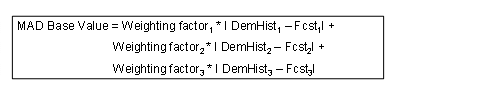
You can enter weighting factors in Customizing under Initialise Base Values. For more information, see the Implementation Guide (IMG) for Advanced Planning and Optimization under Supply Chain Planning → Service Parts Planning (SPP) → Forecasting.
2. The system calculates the MAD according to the following formula:

i represents the current period.
You can specify alpha from the SAP Easy Access menu under Advanced Planning and Optimization → Service Parts Planning (SPP) → Planning → Forecast → Forecast Profile on the Model Parameter tab page in the Alpha Factor field. In the DMA model you specify alpha on the Model Parameter tab page in the MAD Smoothing Factor for Demand in DMA Model field.
i-RLT represents the period, in which the forecast for period i was created. You can specify this value in the forecast profile on the General tab page in the Offset Forecast Creation field.
n is the number of periods that you defined in the forecast profile on the Model Parameter tab page.
The following table gives you an overview of which parameters you must define for which forecast model:
Forecast Model |
Parameter |
First-order exponential smoothing |
Periods StdDev./MAD for First-Order Exponential Smoothing |
Second-order exponential smoothing |
Periods StdDev./MAD for Second-Order Exponential Smoothing |
Moving average |
Periods StdDev./MAD for Moving Average |
Linear regression model |
Periods StdDev./MAD for Linear Regression |
Seasonal trend model |
Periods StdDev./MAD for Seasonal Trend Model |
Seasonal trend model with fixed period groupings (FPG) |
Periods StdDev./MAD for Seasonal Trend Model with FPG |
Intermittent forecast model |
Periods StdDev./MAD for Intermittent Forecast Model |
Dynamic moving average |
Periods StdDev./MAD for Dynamic Moving Average |
Declining demand forecast (DDF) |
Periods StdDev./MAD for Declining Demand Forecast |