
 Hierarchy Nodes

Definition
Hierarchy nodes are components of a characteristic hierarchy. A characteristic hierarchy is assigned to a hierarchy basic characteristic and therefore is affected by the valid hierarchy properties Version Dependency, Time Dependency, Interval, and Sign Reversal for all hierarchies assigned to this characteristic (see Hierarchy Properties).
The structure of a characteristic hierarchy is defined by the link relationships among the hierarchy nodes.
· Each node has exactly one parent node (predecessor). The “depth” (the level) of the node corresponds to the number of its predecessors increasing up to the root of one. This means that the roots have level 1.
· The assigned quantity of children or subnodes (successors) is assigned to each node. The “degree” of a node corresponds to the number of its successors.
· Nodes that show special features in one of the two relationships are roots (nodes) and leaves. All nodes are indicated as inner nodes whose degree is not zero, meaning they have successors.
· With regard to the structure of a hierarchy, the hierarchy nodes are assembled into hierarchy levels and subtrees.
Depending on whether a node refers to a hierarchy basic characteristic or not, we differentiate postable and not postable nodes.
All nodes (except for leaves and link nodes) can only occur once in a hierarchy. You can find additional information under Modeling Nodes and Leaves and Link Nodes.
Structure
Special hierarchy nodes
Hierarchy Nodes |
Description |
Root (nodes) |
A node that is not assigned under any node and has no parent node (predecessor). A hierarchy can have more than one root node. |
Leaf |
A node without lower-level nodes (successors). Leaves are postable, but are not postable nodes (see table below “Postability of Nodes”). Leaves are always characteristic values for the hierarchy basic characteristic. Value specification: The value is moved from the InfoProvider. |
Interval |
A quantity of leaves that are indicated by their lower and upper limit. |
A node having successors, meaning all nodes except for leaves. |
Grouping of hierarchy nodes
Grouping |
Description |
Hierarchy level |
A hierarchy level consists of all nodes with the same depth. Root nodes have depth (level) 1. The depth of a node corresponds the number of parent or grandparent nodes up to the root node + 1 (increased by one) A hierarchy can have a maximum of 98 levels. Each level can have a name. |
Subtree |
A subtree includes a node (root node of the subtree) with its lower-level or subnodes. Nodes that are on the border of a subtree are called border nodes. This is important for hierarchy authorizations (see Maintaining Authorizations for Hierarchies). |
Postability of nodes
Postability |
Description |
Postable nodes |
A node that corresponds to a characteristic value for the hierarchy basic characteristic. (A node that corresponds to a characteristic value for a characteristic that references the hierarchy basic characteristic. This definition includes the hierarchy basic characteristic.) In contrast to a leaf, additional nodes or leaves are assigned under a postable (inner) node. Value specification: The value of a postable node is specified by the aggregation of the values of its lower-level nodes and of its value in the InfoProvider. You can find an example under Modeling Nodes and Leaves. |
Not postable nodes |
A node that does not refer to a hierarchy basic characteristic and is not a postable node (see Text Nodes, External Characteristic Nodes). Value specification: The value of a node that is not postable is specified by the aggregation of the values of its children nodes. |
Text nodes |
A text node is a new, artificial term. Text nodes are special characteristic nodes for the artificial characteristic 0HIER_NODE. |
External characteristic nodes |
A node that is identified by any specification of any InfoObject is an external characteristic node. In order to be able to use a characteristic in the hierarchy as an external characteristic node, this has to be explicitly selected in the InfoObject maintenance for the hierarchy basis characteristic. |
Not assigned |
The system automatically creates a root node REST_H, under which all characteristic values hang. These characteristic values exist in the master data, but are not explicitly arranged in the hierarchy. The node Not Assigned guarantees that no data is lost when activating a presentation hierarchy (see Characteristic Properties). In the query, this node is always collapsed first and also does not react to Expand to Level. However, it can be explicitly opened. |
Hierarchy balance
Hierarchy type |
Description |
Unbalanced |
A hierarchy whose leaves are on different levels is called an unbalanced hierarchy. If different sources of information are delivered with a different degree of detail (for example, one to the Material level, another only to the Material Group level), this can cause unbalanced hierarchies (see the example below). |
Balanced |
A hierarchy whose leaves have all the same depth is called a balanced hierarchy. A balanced hierarchy, in which all nodes for a level have the same semantics (such as characteristic nodes with the same characteristic), is called a Named Level Hierarchy (see example 1 below). In the level maintenance you can assign the levels for the respective texts (see Level Maintenance). Typical examples of these hierarchies are geographic hierarchies, for example, with the levels Continent – Country – State – Region – City or time hierarchies (see the example below). |

SAP NetWeaver Business Intelligence can process both balanced as well as unbalanced hierarchies without restriction.
Example
Example 1
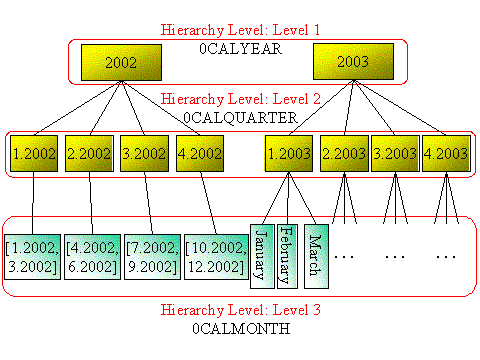
The following graphic gives an example of a hierarchy for InfoObject Month 0CALMONTH to illustrate the relationships between the hierarchy nodes and their grouping in hierarchy levels.
This time hierarchy is a typical example of a balanced hierarchy. It has several root nodes because the nodes with characteristic values 2002 and 2003 for the InfoObjects transferred in addition to the time characteristic Year 0CALYEAR (external characteristic node), do not commonly hang under a special parent node (like a text node Year).
The hierarchy has three levels. Since each level corresponds to an InfoObject (0CALYEAR, 0CALQUARTER, 0CALMONTH), it concerns a Named Level Hierarchy.
Postable nodes are green, while nodes that cannot be posted are displayed in yellow. The definition of the nodes 1.2002/0CALQUARTER and 1.2003/0CALQUARTER are equivalent. The specification of intervals as a summary of several leaves only serves as a more comfortable entry, but is not a new structure component.
Example 2a
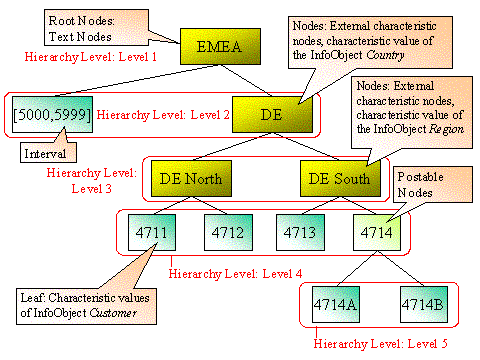
The following graphic gives an example of a hierarchy for InfoObject Customer to illustrate the relationships between the hierarchy nodes and their grouping in hierarchy levels. This customer hierarchy is a typical example of an unbalanced hierarchy and only has one root node. Postable nodes and leaves are green, while nodes that cannot be posted are displayed in yellow.
Example 2b
The following graphic gives an example of a hierarchy for the InfoObject Customer to illustrate the display of such a hierarchy for the time of your modeling in the hierarchy maintenance. The different node types are displayed as follows:
· Folder symbol: Text nodes, in this case the root node Customer Hierarchy
· Yellow InfoObject symbol: Nodes that cannot be posted with characteristic values for the additionally transferred InfoObjects Region (External Characteristic Nodes) in the customer hierarchy
· Green InfoObject symbol: Postable nodes and leaves for the InfoObject Customer

See also: