 Example: Event-Driven Evaluation of Hardware Services Suppliers
This example is based on the following assumptions:
The acceptance of a service entry sheet has been defined as a triggering event.
In the SAP ERP BAdI for service entry sheets MB_DOCUMENT_BADI, the following has been defined:
For an evaluation triggered by a service entry sheet, the user accepting the service entry sheet acts as appraiser.
The evaluation template for suppliers of hardware services (see section Creation of an Evaluation Template for Hardware Services Suppliers) is used for service entry sheet items of product categories related to the purchasing category hardware services.
The following figures show the following:
The creation of an evaluation template for hardware services suppliers
The follow-on documents of the evaluation template in context
The sequence of user activities and system activities in an evaluation of hardware services suppliers triggered by a user accepting a service entry sheet
1. Creation of an Evaluation Template for Hardware Services Suppliers
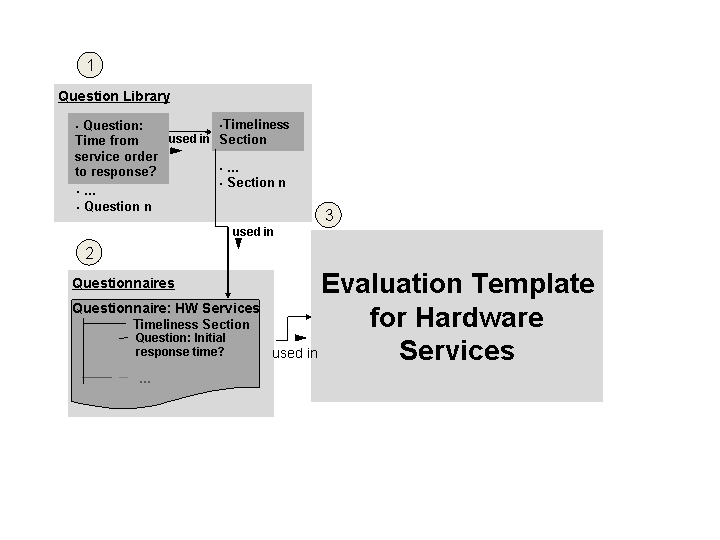
An employee with the role Questionnaire Manager creates questions and sections in the question library. These are supposed to be used in questionnaires about the suppliers of hardware services. Questions and sections are based on criteria that are important to measure supplier performance. One criterion could be “timeliness of service provision”, which serves as a section in this example. Questions relating to quality may address the response time after a service order has been posted, for example.
The Questionnaire Manager can assign scores to the answer options of certain question types. For more information, see Scores and Weightings.
The Questionnaire Manager puts together a questionnaire for suppliers of hardware services, selecting the appropriate questions and sections from the question library. The questions can be specific to the hardware services industry, or of a general content.
The Questionnaire Manager can assign weightings to sections and questions in the questionnaire. For more information, see Scores and Weightings.
The Category Manager creates an event-driven evaluation template for suppliers of hardware services, and assigns the questionnaire created in step 2 to it. He or she releases the template.
As a result, the evaluation template can be used in evaluations triggered by events in connected operational procurement systems.
2. Follow-On Documents of the Evaluation Template

The category manager for hardware services enables the event-driven evaluation process by clicking Start Event-Driven Evaluation in the template for hardware services. An evaluation request based on the template for hardware services is created. The request inherits the questionnaires from the template. The request has a validity period, which is unlimited at the moment of its creation. However, it can be replaced with another request, for example, to use the newly assigned questionnaires of a changed template. In this case, the validity period of the original request ends as soon as the validity period of the new request has started.
The Category Manager also defines a scorecard interval in the evaluation request, for example, three months.
The existence of a valid request is a prerequisite for the event-driven evaluation process. In this example, once the evaluation request for suppliers of hardware services has been created, it can be used by triggering events in the category of hardware services.
Whenever an event occurs that requires the template for hardware services, the evaluation request is used to send the assigned questionnaires to the appraiser.
After having completed these questionnaires, the appraiser sends them back with his or her evaluation response.
The results from all responses with reference dates within the same scorecard interval are aggregated into one scorecard for each supplier.
3. Sequence of User Activities and System Activities
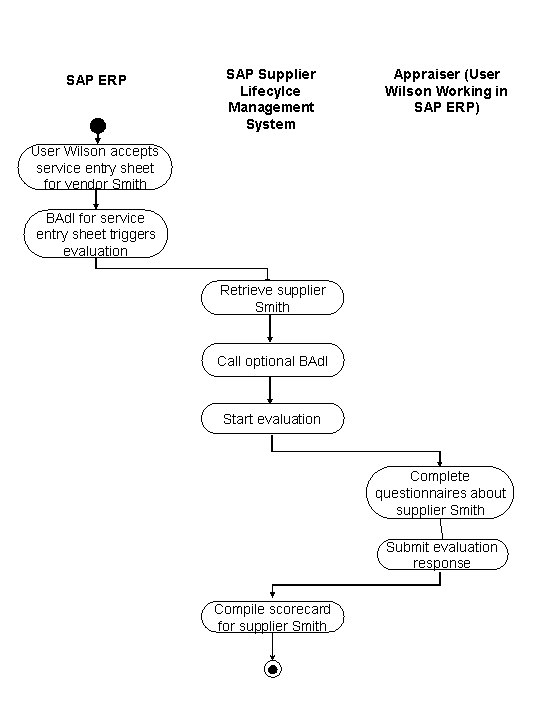
User Wilson accepts service entry sheet for vendor Smith: To confirm services that have been provided by vendor Smith, user Wilson accepts the service entry sheet listing these services in SAP ERP.
BAdI for service entry sheet triggers evaluation: The BAdI for service entry sheets in SAP ERP provides parameters for the evaluation and calls the function module /SRMSMC/EV_EVENT_INBOUND in SAP Supplier Lifecycle Management. In this example, the BAdI defines user Wilson as the appraiser and supplier Smith as the supplier to be evaluated, as well as the template for hardware services as the template to be used in this evaluation.
The execution of this function module comprises the following three steps.
Retrieve supplier Smith: In SAP Supplier Lifecycle Management, the supplier corresponding to the back-end vendor Smith is determined.
Call optional BAdI: In this example, the optional BAdI /SRMSMC/BD_EV_EVENT_INBOUND provides no additional parameters.
Start evaluation: The questionnaires assigned to the evaluation request created from the evaluation template for suppliers of hardware services are sent to user Wilson.
Complete questionnaires about supplier Smith: By the response deadline specified in the evaluation request, user Wilson completes the questionnaires about supplier Smith.
Submit evaluation response: User Wilson sends back the completed questionnaires to the SAP Supplier Lifecycle Management system (evaluation response).
Compile scorecard for supplier Smith: The response from user Wilson updates the scorecard for supplier Smith for the relevant scorecard interval. The scorecard for supplier Smith helps the category manager for hardware services to devise measures to further develop the business relationships with this supplier, that is, to develop the supplier company's strengths and correct its shortcomings.
For more information about implementing the event-driven evaluation process, including example implementations, see SAP Note 1669537.