 Scheduling Third-Party Order Processing by Source Determination
Purpose
The system can use this process to determine a delivery date for third-party order processing by source determination.If the customer has specified a requested delivery date, scheduling enables the products to be delivered on this date. The system calculates the delivery date based on configurable process scheduling . The system uses transportation and shipment scheduling to call configurable process scheduling.
Scheduling in third-party order processing is particularly important if the supplier's stock cannot be seen in SAP APO, and if no scheduling takes place in the supplier's system.
Prerequisites
Before the system can call configurable process scheduling, you must make the required Customizing settings in transportation and shipment scheduling.
For more information, see Scheduling Using Configurable Process Scheduling .
Besides the SD date types and activity types, the scheduling schema SCHEDL_TPOP for configurable process scheduling must contain the following date and activity types that are relevant for third-party order processing:
Latest
sales order creation date
(date type OEDAT)Latest
purchase order creation date
(date type PODAT)Purchase order processing time (activity type POPT)
Order processing lead time of supplier (activity type SLEA)
Order processing (activity type ORDPROC)
For more information, see the Implementation Guide (IMG) for
SAP SCM
under
SCM Basis

Configurable Process Scheduling
Scheduling Schema
 .
.
You can use the scheduling schema SCHEDL_TPOP or create your own schema for scheduling in third-party order processing. Your own schema must contain all the activity types and date types of the scheduling schema SCHEDL_TPOP in the same order.
Process
Scheduling proceeds differently depending on whether the system performs scheduling based on the requested delivery date or on the material availability date.
Scheduling Based on the Requested Delivery Date
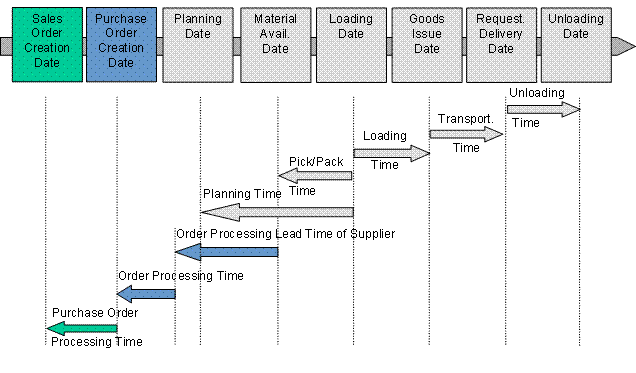
In this type of scheduling, the requested delivery date is given. Based on this date, the system calculates all other dates such as the purchase order creation date and loading date. To calculate the dates, the system uses the known times for the individual activities such as loading time or transportation time.
The calculation of the individual dates is a prerequisite for all dates being able to be adhered to. If the dates are adhered to, you can ensure that your customer receives the products on the requested delivery date.
Scheduling based on the requested delivery date consists of the following steps:
Requested delivery date plus unloading time
Based on this addition, the system calculates the unloading date.
Requested delivery date minus transportation time
Based on this subtraction, the system calculates the goods issue date.
Goods issue date minus loading time
Based on this subtraction, the system calculates the loading date.
Loading date minus pick/pack time
Based on this subtraction, the system calculates the material availability date.
Loading date minus planning time
Based on this subtraction, the system calculates the planning date.
Material availability date minus order processing lead time of supplier minus order processing time
Based on this subtraction, the system calculates the purchase order creation date. The purchase order creation date refers to the latest date on which the supplier should receive the purchase order.
Purchase order creation date minus purchase order processing time
Based on this subtraction, the system calculates the latest possible sales order creation date.
The following figure illustrates the process steps that the system performs when it executes scheduling based on the requested delivery date.
Scheduling Based on the Material Availability Date
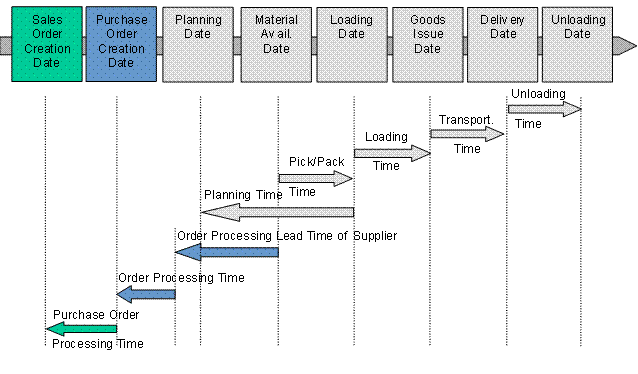
In this type of scheduling, the material availability date is given. The system calculates all other dates based on the material availability date.
Scheduling based on the material delivery date consists of the following steps:
Material availability date minus order processing lead time of supplier minus order processing time
Based on this subtraction, the system calculates the purchase order creation date.
Purchase order creation date minus purchase order processing time
Based on this subtraction, the system calculates the order creation date.
Material availability date plus pick/pack time
Based on this addition, the system calculates the loading date.
Loading date minus planning time
Based on this subtraction, the system calculates the planning date.
Loading date plus loading time
Based on this addition, the system calculates the goods issue date.
Goods issue date plus transportation time
Based on this addition, the system calculates the delivery date.
Delivery date plus unloading time
Based on this addition, the system calculates the unloading date.
The following figure illustrates the process steps that the system performs when it executes scheduling based on the material availability date.
Result
The system calculates a delivery date for the products. After scheduling, the system creates a planned purchase order.