Calculation of Requirement Dates for Components
Use
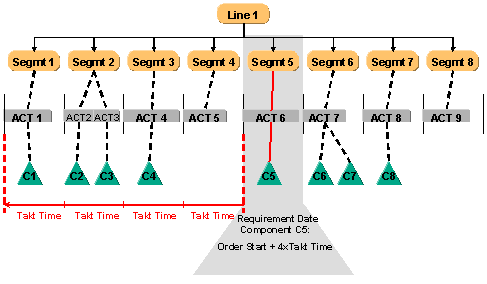
With this function you can determine the exact requirement dates for the components, depending on the structure of the line network. This is particularly important for complex lines with relatively long lead times, as the requirement dates can vary from the start date of an order.
You can determine the exact requirement dates both for simple line networks and for line networks with groups of alternative lines.
Integration
The system calculates the requirement dates in takt-based scheduling, which takes place during production planning in the SAP APO system using the
Rapid Planning Matrix
. See also:
Takt-Based Scheduling
and
Takt-Based Scheduling in Line Networks
.
For further information, see the documentation for the Rapid Planning Matrix in SAP APO.
Prerequisites
You have created a complete data model in Integrated Product and Process Engineering. You have assigned the components to the activities (see also Assigning Components ) and have assigned the activities to the line segments within a line balance .
Features
By assigning the activities to line segments, you indirectly determine the points on the production line at which specific components are assembled. With the line and the line balance you therefore determine the assembly points for components. In this way, the system can determine time shifts for components relative to the order start.
The system determines how many takts an order must pass through to reach the assembly location for a specific component. It multiplies this number of takts with the takt time and thus obtains the difference between the order start and the requirement date for a specific component (lead-time offset).
If the start date is changed, the Rapid Planning Matrix automatically adjusts the requirement date for the components.
So that a procurement element does not have to be generated for each dependent requirement, you can group together the component requirements if necessary.
When you use groups of alternative lines, the system uses the alternative line that is specified in the planned order and determines the point on this line at which the components are assembled. If the planned order is rescheduled during sequencing to a different line from the group of alternative lines, the Rapid Planning Matrix automatically updates the assembly location and the relevant requirement dates for the components.
Example