 Data Realignment for Supersession
Use
If you work with supersession when planning, the system considers supersession for inbound order items during historical data capture. The system considers the demands of these items for both the demand history of the predecessor product and the demand history of the successor product. During historical data capture, the planning service “SPP: Data Realignment for Supersession” realigns the demand history on the successor product planning date . This planning service copies the demand history of predecessor products into the demand history of successor products.
 Note
Note
Do not change or delete the master data for product and location interchangeability of a product as soon as the successor product planning date of this product has passed.
Prerequisites
You have scheduled the “SPP: Data Realignment for Supersession“(SPP_PDEM_SUPERSESSION_RLG) in the Planning Service Manager (PSM).
 Recommendation
We recommend that you schedule this planning service daily and before the other planning services for the data realignment of demand history.
Recommendation
If you have scheduled this planning service daily, we recommend that you enter the value
0
in the service profile of this planning service in the
Days in the Past
field.
In the process profile, you have specified the method PRODUCT_INCMD as the package creation method.
For more information, see Use of the Planning Service Manager in SPP and PSM Services for Demand History Creation .
Features
When the successor product planning date is reached, the planning service copies the demand history of the predecessor product to the demand history of the successor product.
The planning service only writes the changes in the DataStore object 9ADEMCRT. The planning service does not change the raw data in the DataStore object 9ARAWCRT.
The system follows the same logic as it does for historical data capture. For a description of this logic, see
Handling of Supersession
in the
Features
section.
The planning service first performs data realignment of the demand history for the current item in the master data for product and location interchangeability. It then checks whether there are other supersession chains that contain the predecessor product. If so, the planning service realigns all demand histories of all predecessor and successor products.
It then sets the trigger SPP_RLG_DONE. This triggers the forecasting service.
Example
The following figure shows the procedure described above:
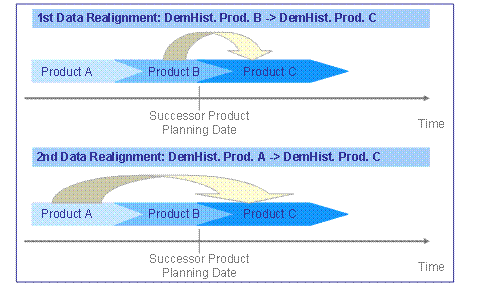
At the successor product planning date, the planning service performs the data realignment for the replacement of product B by product C. It then checks whether there are other supersession chains that contain product B and finds the supersession chain in the past in which product B replaced product A. The system therefore performs a second data realignment and also considers the demand history of product A when creating the demand history for product C.