
 User Data Synchronization

The J2EE Engine has an open service provider architecture for storing user data. In the standard system, SAP uses the user data management functions of the user management engine (UME) store provider. The UME is the default active user store interface on the AS Java. The UME itself has a number of options for storing user data.
For more
information, see
 UME Data Sources
in the UME documentation.
UME Data Sources
in the UME documentation.
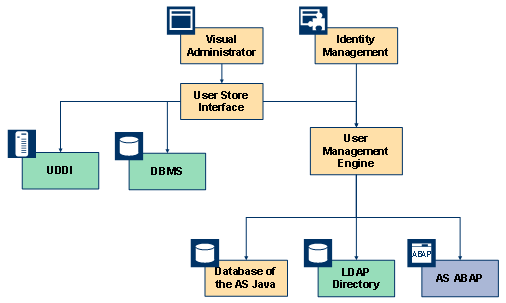
User Stores and Data Sources of the AS Java
User Data Management in UME
The UME is the default user administration provider on the J2EE Engine. Consistent with the open architecture of user management in the AS Java, the UME allows you to import and export user data from and to LDAP, database or AS ABAP data sources. You can use the transport layer security mechanisms available for the corresponding communication protocols to secure the remote communication for UME data sources. For more information, see Communication Security for Persistency Stores.
For an overview of the architecture of the
UME, see
User Management Engine.
For identity provisioning, UME provides a remote interface using the Service Provisioning Markup Language (SPML) standard. Using the SPML APIs of the UME, you can perform identity management functions on users, group and role objects. The APIs can be used for user management with all of the data sources (SAP system, LDAP server or other database), supported by the UME.
The AS-Java can accept SPML requests to perform the following identity management functions. The available functions can also be bundled together in batch requests:
● Creating objects
● Modifying objects
● Searching for objects
● Deleting objects
The J2EE Engine accepts and processes the SPML request using Simple Object Access Protocol (SOAP) messages (according to the SPML 1.0 Bindings specification). The URL address used by the SPML service on the J2EE Engine is <server>:<port>/spml/spmlservice.
For more
information and configuration details, see
Concept of
Interchangeable User Stores and
Configuring Identity
Management in the Administration
Manual.
For reference
material on the UME, including information on UME properties and configuration
files, see
Reference
Documentation for User Management.
See also: