 ILM-Aware Storage
In an end-to-end ILM strategy both the application side and the storage side must be considered. Therefore, an essential part of ILM is ILM-aware storage integration, based on secure, preferably WORM-like, storage technology. In an ILM strategy, the life cycle actions that occur with the data from your SAP system are based on the rules and policies entered in the Information Retention Manager (IRM), which are propagated to the storage system in the form of properties at the time of storage.
The following concepts show what ILM-aware storage means and how it fits into a complete ILM strategy:
ILM-enhanced WebDAV interface: ILM from SAP uses an ILM-enhanced WebDAV interface for information transfer between the application system and storage. Through the enhanced WebDAV interface not only data is transferred to final, ideally WORM-like, storage, but also metadata is passed on in the form of WebDAV properties. The new WebDAV interface allows for a clear structure for storing data, and also facilitates the passing of properties to the storage system for each node in the hierarchy and for the file itself. Properties with well-defined semantics are for instance the beginning and the end of the retention period as calculated for each archive file with the help of IRM.
WORM-like storage and interface certification: In order for the storage system to understand and allow actions on the stored data based on the rules, it must be able to receive this metadata and act accordingly. If it does, it is considered to be ILM-aware. Storage vendors can obtain an ILM certification from SAP to show that their storage systems are ILM-aware. When you are choosing a storage system to support you in your ILM strategy, it is important to check whether it meets certain criteria. For example, it should support both the non-deleteability as well as the destruction of data on request. This will ensure that your data is kept for the entire retention period required by law, and then destroyed at the correct point in time. Likewise, a storage system should be able to guarantee that stored data cannot be changed or modified in any way. WORM-like magnetic storage technology is best-suited for the purpose of ILM from SAP. For more information on certified partners see
 https://www.sdn.sap.com/irj/sdn
 Partners and ISVs Integration
and Certification
Partners and ISVs Integration
and Certification  .
.Archive hierarchy and structured data: To enable you to use ILM-aware storage for your archived data, you can store your archive files using the new ILM-enhanced WebDAV interface. When you choose this option, the archive files are stored in a hierarchy that reflects the parameters which are determined by the retention rule in the IRM and is built at the time of storage. Truly archived data (moved data) and snapshots (copied data) are stored in separate hierarchy paths, whose nodes are formed using the parameters for the determination of the IRM rules as the origin. As you can see in the graphic, archived data is automatically stored under node AD, while Snapshots are automatically stored under node SN.
Archive hierarchy and unstructured data: It is also possible to manage the retention of the unstructured data (incoming or outgoing documents, scanned invoices, etc.) that is attached to the structured data. As always, you store the attached unstructured data in a storage system using the ArchiveLink interface. The references to the locations of the unstructured data are then stored in a second hierarchy that corresponds to that of the structured data (if this exists already). The location of each document is stored in the corresponding collection in the parallel hierarchy as its hosting archived business object. This way, the unstructured data appears close to its corresponding structured data and inherits the same life cycle metadata. As you can see in the graphic, the references to documents stored using ArchiveLink are automatically saved under the node AL, while the references to print lists stored using ArchiveLink are automatically saved under the node DL (from the German word Drucklisten).
 Note
NoteNote that even though unstructured data is stored using a different interface, it is entirely possible and even intended that both the structured and unstructured data is stored in one and the same enterprise archive, depending on the interface openness of the storage vendor.
End of the note.
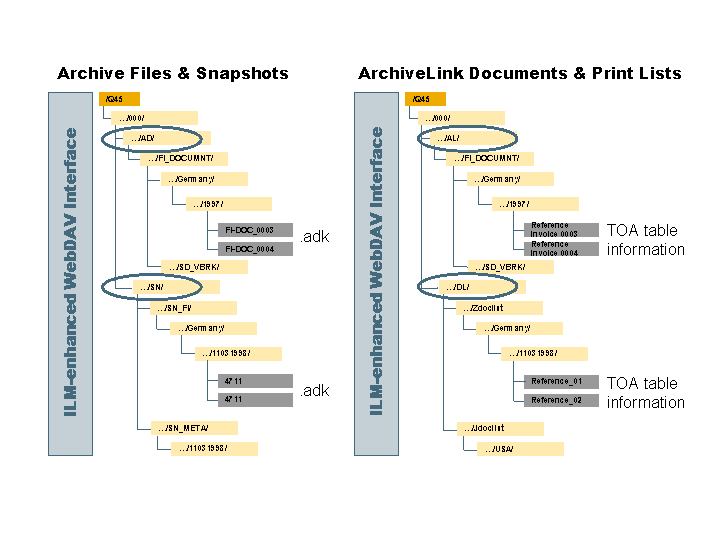
The Archive Hierarchy is Built According to the Rules Entered in IRM and the Type of Data Archived