 Price Allocation for Structured Performance Obligations
Performance obligations in a contract can be structured hierarchically to address specific business scenarios. Price allocation considers the structure as follows:
From the top down
When allocating the transaction price, the system passes the transaction price down the tree structure. The system first splits the transaction price among the performance obligations that do not have a higher-level performance obligation (A, D, and E in the diagram). These performance obligations are at the root of the tree structure. Then, for each of these performance obligations, the system passes the distributed amount further down to its lower-level performance obligations (from A to B and C in the diagram). The system continues this process until it walks through the entire tree.
The system treats performance obligations that have the same higher-level performance obligation (B and C in the diagram) or no performance obligation (A and B) should be a group (A, D, and E). Allocation occurs among the group first, and then for each group member.
Fair value check
The standalone selling price can be a price range (set by a standalone selling price tolerance) as opposed to a single value. Before splitting an amount among a group of performance obligations, the system checks whether the price originally assigned is within the boundaries set by the standalone selling price tolerance. If the price exceeds the range, the system splits the amount among the group. If the price does not exceed the range, the members of this group keep their original amounts, but these amounts can be passed down for further allocation.
Linked performance obligations
A leading performance obligation is considered to be at the same level as its linked performance obligations (D and E in the diagram). However, a leading performance obligation and its linked performance obligations are always paired together in terms of fair value check. When checking the fair value of a leading performance obligation, the system first aggregates the standalone selling prices on both the leading performance obligation and its linked performance obligations ($60+$40 in the diagram). The system then compares the original price of the leading performance obligation with the total of the standalone selling prices ($100 in the diagram).
If the combination of leading and linked performance obligations is verified as sold at fair value and if all the other performance obligations in the same group are verified as sold at fair value, the price is not split among the group (A, D, and E in the diagram). However, price allocation must occur between the leading performance obligations and its linked performance obligations (between D and E in the diagram).
If the combination of leading and linked performance obligations is verified as not sold at fair value or if any of the other performance obligations in the same group is verified as not sold at fair value, price allocation occurs among all performance obligations in the group (A, D, and E in the diagram).
Sales BOM structures
For a sales BOM structure, the system always allocates the price down to the item level of the BOM structure, regardless of where the pricing conditions are assigned.
Compound performance obligations
For a compound performance obligation, the system proceeds as follows:
If the transaction price is calculated from the pricing conditions assigned on those non-distinct performance obligations, the system allocates the price down to the level of the non-distinct performance obligations.
If the transaction price is calculated from the pricing conditions assigned on the compound performance obligation, the system allocates the price only down to the compound performance obligation.
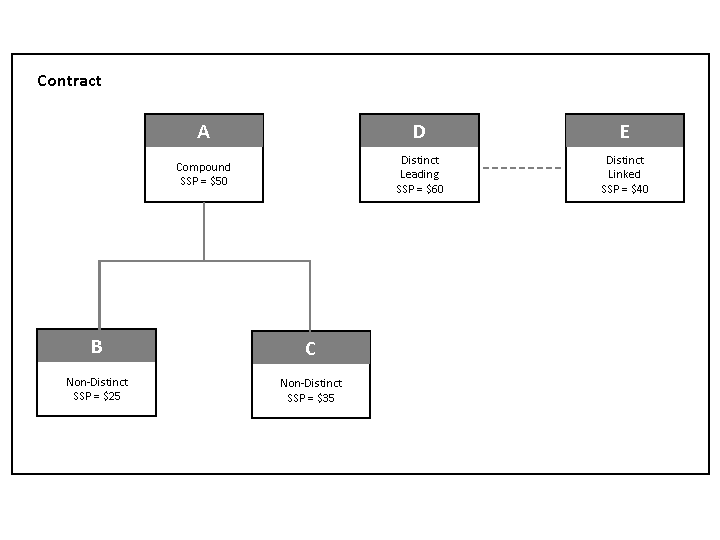
Example: Price Allocation in a Hierarchy