
 Job-definition.dtd

Definition
An XML Document Type Definition that describes how you can specify additional information about job definitions. Every job definition must have a job-definition.xml deployment descriptor.
Structure
The job-definition.xml has the following structure:
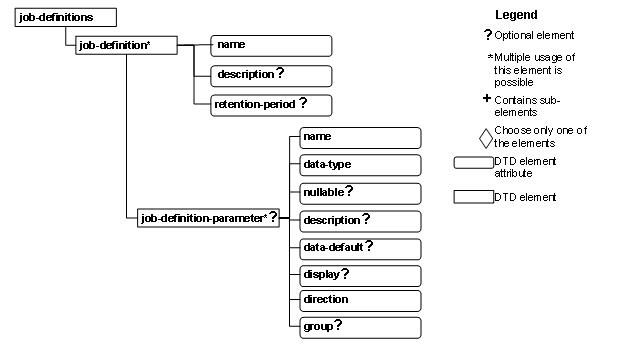
DTD Description

When you do not specify optional attributes in the job-definition.xml, Java Scheduler assumes the above mentioned default values. “null” denotes that fact, that an attribute remains unset.
DTD Element / Attribute |
Description |
job-definitions |
The root element of this deployment descriptor. It contains one or more job-definition elements. |
job-definition |
This element contains additional information about one job definition. Used in: job-definitions. Contains: name, description, retention-period and job-definition-parameter*. |
name |
The name of the job definition. The value of this attribute has to be the same as the value of the message selector specified in the JobBean class. It is composed of letters, digits, hyphens (-), and underscores ( _ ) and must have a length of 1 – 230. The job definition is displayed with this name in Job Management in the SAP NetWeaver Administrator. Used in: job-definition. The name attribute is required. |
description |
A free text description of at most 1024 characters of the job definition. The description is displayed in Job Management in the SAP NetWeaver Administrator. Used in: job-definition. The description attribute is optional. Default value: null |
retention-period |
Determines the default number of days, for which the job logs are persisted in the database. The possible values are: ● Positive number (n) Keep the job for the specified n days. ● 0 Do not keep the job logs ● -1 Keep the job logs forever.
When you create a scheduler task, you can change the default retention period specified in the job-definition.xml. Used in: job-definition. The retention-period attribute is optional. Default value: 23 |
job-definition-parameter |
This element contains additional information about job parameters. Used in: job-definition. Contains: name, data-type, nullable, description, data-default, display, direction, and group. Used in: job-definition-parameter The job-definition-parameter element is optional. |
name |
The name of the parameter. It is composed of letters, digits, hyphens (-), and underscores ( _ ) and must have a length of 1 – 255. The parameter name you specify here has to be the same as the name you specify for the parameter in the JobBean class. Used in: job-definition-parameter The name attribute is required. |
data-type |
The type of data passed by the parameter. The supported data types are: string, float, double, integer, long, Boolean, date, and properties. Used in: job-definition-parameter The data-type attribute is required. |
direction
|
Specifies whether the parameter is incoming or outgoing for the job. The following directions are possible: ● IN The parameter is passed to the job. The parameter value provides input for the job to process. ● OUT The parameter is passed from the job. The parameter value is the job’s output. ● INOUT The parameter is passed to the job, the job processes it, and then passes it out. The values of all parameters from the execution of each job instance are stored in the database. The parameter values from a job execution are not overwritten with the parameter values from successive job executions. For example, if a job that has OUT parameters runs twice, the values of the OUT parameters for each of the two job executions is persisted. The value of the OUT parameter from the second job execution does not overwrite the value of the OUT parameter from the first job execution. Used in: job-definition-parameter. The direction attribute is required. |
description |
A free text description of at most 200 characters of the parameter. The description is displayed in the Scheduler Administrator. Used in: job-definition-parameter. The description attribute is optional. Default value: null |
data-default |
The default value that the parameter takes if no value is explicitly specified when a scheduler task is created for the job definition. The length of this string is not restricted. Used in: job-definition-parameter. The data-default attribute is optional. Default value: null |
display |
Specifies whether the parameter appears in the user interface when the job is scheduled. The possible values are: ● Y The parameter is displayed. ● N The parameter is not displayed. Used in: job-definition-parameter. The display attribute is optional. Default value: N |
nullable |
Defines whether the parameter is optional when a scheduler task is created for the job definition. The possible values are: ● Y The parameter does not have to be specified, for example if it is optional. ● N The parameter has to be specified, for example if it is required. Used in: job-definition-parameter The nullable attribute is optional. Default value: N |
group |
To improve readability, job parameters can be grouped in Job Management in the SAP NetWeaver Administrator. This property defines the group in which a parameter shows in Job Management. The length of this string is at most 255. Used in: job-definition-parameter. The group attribute is optional. Default value: null |