
 Technical Basis

The following section describes the specific functional characteristics of the different communication technologies in more detail. Application examples are used to demonstrate which technologies are particularly suitable for which implementation.
Synchronous and Asynchronous Communication
Communication between two systems can be basically split into two types: Synchronous and asynchronous communication. Both forms of communication have specific advantages and disadvantages, relating to either the business application or the system administration.
Synchronous Communication
Synchronous communication uses a single function call. Prerequisite for this is that at the time the call is made (or the message is sent), the receiving system is also active and can accept the call and further process it if necessary.
· Advantage: Synchronous communication can be implemented in function calls that require the immediate return of data to the sender system.
Example: You create a purchase order with account assignment in the sender system, and you want to perform a budget check in central accounting before you save the purchase order.
· Disadvantage: You need to ensure that both systems are active and can be contacted. If they are not, this can lead to serious disruption of processes. In particular, problems can arise if the receiving system is not available for long periods of time due to maintenance (for example, for a system upgrade).
For
asynchronous communication, the receiving system does not necessarily
have to be available at the time a function call is dispatched from the sender
system. The receiving system can receive and process the call at a later time.
If the receiving system is not available, the function call remains in the
outbound queue of the sending system, from where the call is repeated at
regular intervals until it can be processed by the receiving
system.
·
Advantage:
The receiving system does not have to be available at the time the function
call is made. If the system is unavailable for a long period of time, for
example, for an upgrade, it can still process the data that has been sent in
the interim at a later time, and processes in the sending system remain
unharmed. Example: You are sending a purchase order to a
vendor system. The sending system cannot influence the availability of the
receiving system. If the receiving system is not available, the purchase order
can be sent repeatedly until the vendor system is available again.
·
Disadvantage:
Processes that require an immediate response to the sender system cannot be
executed using this method. _____________________________________________________________________________ The
advantage of sending data in packages is that system resources are employed
more efficiently, because each function call occupies one work process in the
system. Example: You want to distribute 100 material master changes
to other systems. If you send the changes in a package (with 100 pieces) you
only require one work process. If you sent the same 100 material master
changes individually, you would need 100 work processes in the system.
When
using asynchronous communication, you should therefore always carefully
consider the availability of your system resources and the necessity of
immediate data transfer. _____________________________________________________________________________ Which
communication technology is suitable for which purpose? For more information,
see the following examples:
·
Application Examples:
Synchronous Communication
·
Application Examples:
Asynchronous Communication
·
Application Examples:
Communication with Non-ABAP Technologies 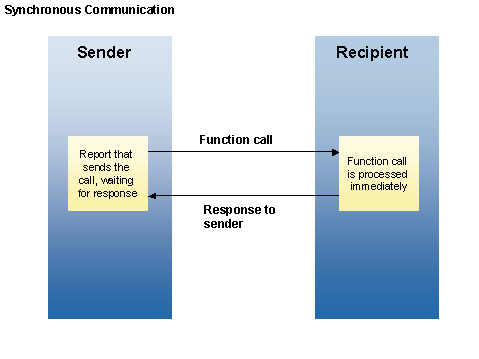
Asynchronous
Communication
 In
asynchronous communication, you usually have the option to send data
(for example, business documents or changes to master data) in packages
or individually (immediately). Note that the Send Immediately
option in asynchronous communication should not be confused with the method
synchronous communication).
In
asynchronous communication, you usually have the option to send data
(for example, business documents or changes to master data) in packages
or individually (immediately). Note that the Send Immediately
option in asynchronous communication should not be confused with the method
synchronous communication).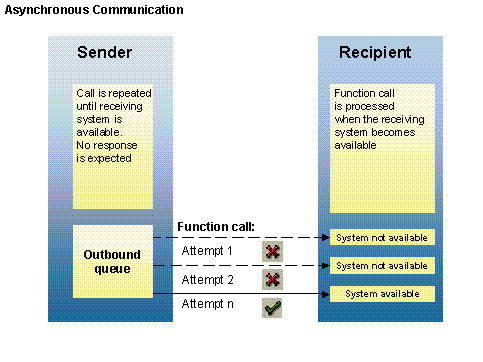
Further
Information