
 Usage Scenarios for the RFC Adapter and
Restrictions
Usage Scenarios for the RFC Adapter and
Restrictions

The RFC adapter maps the following RFC calls to XML messages and the other way around:
● Synchronous RFC calls (sRFCs) in messages with quality of service Best Effort (BE)
● Transactional RFC calls (tRFCs) in messages with quality of service Exactly Once (EO)
● The receiver RFC adapter can also process messages with quality of service Exactly Once In Order (EOIO). They are mapped to transactional RFC calls (tRFC).
See: RFC Calls
See:
 Quality of
Service
Quality of
Service
Usage Scenarios
The following three scenarios are possible when using the RFC adapter and the Integration Engine:
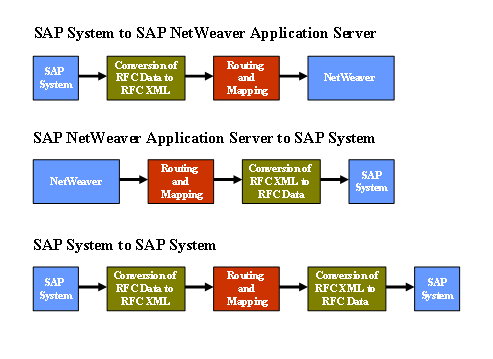
SAP System to SAP NetWeaver Application Server
● Register the RFC server program of the RFC adapter at the gateway of the SAP system.
● Change the RFC destination in the SAP system to reference the registered RFC adapter.
● Provide mappings for request and response messages.
● Establish logical and technical routing.
SAP NetWeaver Application Server to SAP System
● Provide mappings for request and response messages.
● Establish logical and technical routing.
SAP System to SAP System
● Register the RFC server program of the RFC adapter at the gateway of the SAP system.
● Change the RFC destination in the SAP system to reference the registered RFC adapter.
● Provide mappings for request and response messages.
● Establish logical and technical routing.
Restrictions
Note the following constraints:
● There is no transactional context for more than one RFC call for each LUW (Logical Unit of Work).
● SAPGUI, callbacks, and qRFC are not available.
● Receiver adapters only support external RFC servers that register themselves with an SAP gateway.
You cannot start external RFC servers.
● The context in the called system is not kept open over multiple calls (calls are stateless; there is no session).
● Only the payload of a received message is evaluated. Additional attachments are ignored and not forwarded.
● The receiver adapter can only process valid RFC XML documents, for example, those generated by the sender adapter or by the SAP JCo.
● You cannot use additional XML elements such as XML namespaces (xmlns).
● The sender adapter only supports function modules with at least one parameter (import, export, changing, or tables).
● Unicode and non-Unicode systems are supported. MDMP systems are not supported.
● The RFC metadata repository must be compatible with the sender and receivers systems with respect to Unicode. A Unicode sender or receiver system must have a Unicode RFC metadata repository. A non-Unicode sender or receiver system must have a non-Unicode RFC metadata repository.