 Value Help


Value Help
A new method for implementing value helps that does not use screens and selection screens was introduced for Web applications. This method is somewhat more complicated, but easier to understand and more flexible.
Past Method in the R/3 Environment
In the past, the R/3 environment had a standardized form of value helps that could be defined in the Dictionary. Here you could define the entire value help flow, from the selection of the list of values to the
dialog, right up to the visualization. This made value helps possible whose flow and visualization were standardized to a great extent. It was only possible to include individual requirements in the flow of the search help processor to a limited extent using exits. Alternatively, the value help could also be programmed individually for POV (PROCESS ON VALUE REQUEST) by the application, for example using the corresponding Dictionary interfaces (function modules F4IF_*, F4UT_*).
Changes to the Web Environment
Applications in the Web environment need flexible methods that permit you to implement individual and application-specific value helps. In particular, the visualization should be suitable for the Web. The old screen-based visualization cannot be used here. This is because control of the flow and of dialogs is always the responsibility of the application and not the framework, permitting implementation of an absolutely flexible dialog behavior in the simplest manner.
It is also important to note that the value helps are directed to the particular group of users and are designed to be easy and intuitive to use. A detailed knowledge of the underlying data structures and application flows can only be expected when implementing more complicated searches.
Simple Value Help
In the first step, support is offered for implementing simple value helps from the Dictionary for BSP applications. The value set for value helps whose size, structure or dialog behavior is more complex can be defined with the appropriate Dictionary interfaces for search helps: function modules with prefix 'F4IF_' and 'F4UT_', for example F4IF_DETERMINE_SEARCHHELP, F4IF_EXPAND_SEARCHHELP, F4IF_SELECT_VALUES
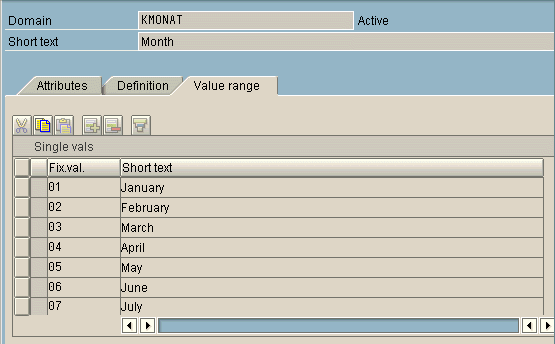
Value helps that return a two-column list of values (such as fixed values) are suitable for use as simple value helps. The second column should be a text column or similar column whose content can be displayed instead of the key. The fixed values for the domain KMONAT, for example, are a suitable value help. These values contain the numbers of the months from 1 to 12 and the corresponding name of the month is assigned to them as fixed value text.

Example
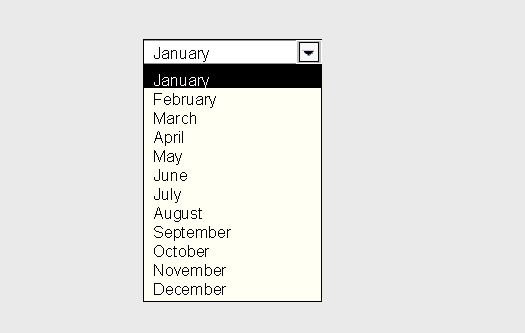
Field with value help with a dropdown listbox:
Fixed values in the Dictionary:
See also:
GET_SIMPLE_HELPVALUES