
 Dependency Scenarios

Dependencies can be defined between data objects in different ways. The following scenarios are possible:
Simple Dependency

Here, the Data Orchestration Engine (DOE) distributes an instance of data object 2 whenever an instance of data object 1 is distributed.
Multi-Level Dependency
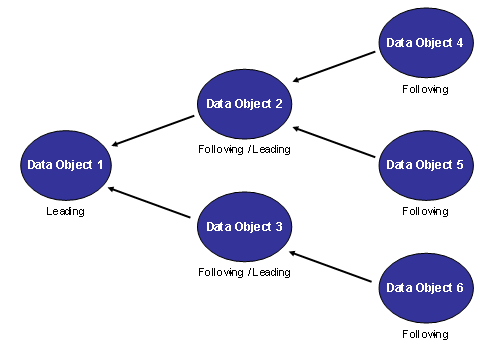
Above data object dependencies have a hierarchical structure. An instance of data object 4, for example, follows an instance of data object 2, which itself follows an instance of data object 1.
Dependency with Multiple Parents

In the example above, the DOE distributes instances of data object 3 whenever an instance of data object 1 or data object 2 is distributed. Of course there could be more data objects involved here, for example, a data object 4, which follows data object 1 or a data object 5, which follows data object 3, and so on.
Interlinked Dependency

This type of dependency captures a m:n relationship between the data objects. This means that the DOE distributes an instance of data object 2 whenever an instance of data object 1 is distributed and vice versa. This could be the case, for example, for a sales order data object and a product data object.
Cyclic Dependency

In the example above, the DOE distributes an instance of data object 2 if an instance of data object 1 is distributed. If data object 2 is distributed by the DOE, data object 3 is distributed. The DOE distributes data object 4 if data object 3 or data object 5 are distributed. If data object 4 is distributed by the DOE, data object 2 is also distributed.