
 Dependencies

The development components (DCs) can use one another and, therefore, depend on each other. A DC can depend on any number of DCs, and a number of DCs can depend on one single DC.
Dependencies between DCs are not static and may change over time. A DC may declare new dependencies or delete existing ones. The dependencies between DCs are only allowed at the same hierarchy level, for example, top-level DCs may depend on each other, or DCs that are included in the same parent DC.
To make possible the use of a public part that is enclosed by another DC, you have to create a public part entity reference.
In the following figure, dependencies are depicted as arrows:
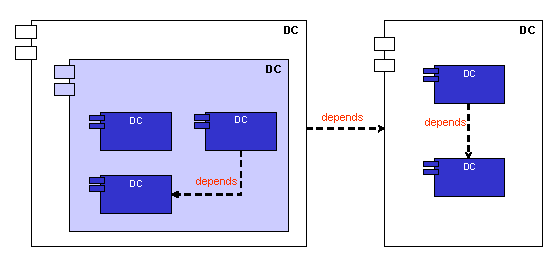
Dependencies between DCs on same hierarchy level
Dependencies of a parent DC are not automatically inherited to child DCs. Child DCs are not allowed to declare dependencies to their parent DC. In contrast, a parent DC can use its DC components.
Dependency Type
We distinguish between four phases in the development cycle of a DC:
● Design Time
Dependencies between DCs can be used by special tools.
● Build Time
Needed for the compilation. This dependency specifies that a DC is used during compilation or when wrapping another DC.
● Deploy Time
Refuses deployment if dependants are missing. This dependency specifies that a used component must already exist in the runtime system to allow the using DC to be deployed.
● Runtime
This dependency specifies that a DC requires another DC at runtime. This means that it can be used meaningfully only if both DCs have deployable results.
You can combine any of these uses.
Rules for Dependencies between DCs
All of the following conditions must be fulfilled, before a DC can use another DC:
● Both DCs have to belong to the same software component (SC). If they do not belong to one and same SC, then you have to declare dependency on a different level. In the using DC you have to explicitly declare dependency to the SC that contains the targeted DC.
● The used DC is either:
○ a top-level DC.
○ a direct child component of the using DC.
○ the parent DC of the used DC is a predecessor of the using DC.
● There is no exclusion in the access control list of the used DC for the using DC.
● The DC types are compatible. There are some exclusion criteria:
○ a normal DC should not use a build-infrastructure DC.
○ DC types dependencies that make no sense should not be used.
The figure below shows allowed and not allowed dependencies, based on the rules stated above:

To use a DC, use dependencies must be created.
Use Dependencies
If you want your development component (DC) to use objects from a public part of another DC you must define use dependencies between these DCs. Use dependencies are checked by the DC build.
Using a development object is allowed if it is named in a public part of its DC and a dependency to this public part has been declared. Note that in a dependency, although you actually use development objects, you declare the dependencies between the DCs.

In the following figure, a Java class Y in DC B wants to implement an interface X in the public part of DC A. This is possible because DC B declares a use relation to public part ppA to which X belongs.
Note that usage relations are ordinary dependencies and, therefore, must obey the usual visibility rules. The class Z in the figure, for example, is not usable for Y.

Using a development object of another DC

Declaring a dependency between DCs is a necessary prerequisite for using a public development object in the public part of another DC, but that alone is not enough. In the example above, according to the Java syntax, Y would have to explicitly import X with the import X statement, before the implementation could be executed. With a use dependency, you declare your intention of wanting to use a DC; the use dependency does not execute this use concretely (depending on the technology of the participating objects).
Cyclic Use Dependencies
Cyclic dependencies are not allowed. You must avoid cyclic dependencies. The best way is to determine the dependencies between function blocks of your software in the planning phase.
A cyclic use dependency is a dependency of the type DC A uses DC B and DC B uses DC A. The cyclic use can also include more intermediate steps, like DC A → DC B → DC C → DC A. The build recognizes the cyclic dependencies and does not build them. The reason is that there is no clear definition of which DC to build first and that a use dependency would have to be violated.