Effects of Distribution Rules
To be able to model your scenarios, you need to understand how the system evaluates the rules and dependencies. The following examples illustrate the difference in rule evaluation by the system, using the same data objects with different dependency and rule scenarios.
Scenario
A sales organization in which the sales centers are organized by zip code ranges. For example, Sales Center A is responsible for zip codes 10000 to 19999, Sales Center B is responsible for zip codes 20000 to 29999 and so on. This range is defined in the back end.
Depending on the exact scope of data you want to be distributed to the devices, there are different options for modeling this scenario. In all the options described below, the sales representatives receive sales orders as well as information on the products and customers involved.
This scenario requires the following data objects:
-
Standard data objects for
-
customer data
-
sales order data
-
product data
-
-
A subscription generation data object for subscribing to data relevant for a specific sales center
-
A receiver generation data object for the individual employees assigned to the sales centers
The data object for which the distribution model is defined must include the main distribution criterion (here: zip code) or a bulk rule must be defined for it.
Option 1
Use the following scenario to ensure that the devices assigned to a sales center receive the following:
-
Only the sales orders that are assigned to the sales center based on the zip code.
-
To ensure this, the data and distribution model must match the following requirements:
All (and only) the customer and the product data related to these sales orders.
-
The Sales Order data object contains the main distribution criterion, the zip code.
-
The distribution model is based on the Sales Order data object.
-
A distribution rule is defined for the Sales Order data object using the subscription generation data object for the assignment of the devices by the corresponding sales center.
-
Two dependencies are defined for the distribution model:
-
Customer data object following the Sales Order data object
-
Product data object following the Sales Order data object.

-
As a result of the solution above, the sales representatives receive all the sales orders for the zip code range assigned to their sales center. Due to the defined dependencies, they also receive the data of the customers who ordered the products and the data of the ordered products.
Example
-
The company has 1000 customers, 200 of which are assigned to the relevant sales center (based on the zip code)
-
The company sells a portfolio of 100 products
-
There are currently 500 sales orders, 20 of which are assigned to the relevant sales center (based on the zip code).
As a result of the scenario defined above, the sales representatives assigned to the sales center receive the following on their devices:
-
The relevant 20 sales orders
-
A maximum of 20 customer records (theoretically the sales orders could all be for one customer, in which case the sales representatives would only receive one customer record).
-
The records of different products ordered (for example 20, if all the sales orders are for different products).
Option 2
Use the following scenario to ensure that the devices assigned to a sales center receive the following:
-
All the sales orders of the company.
-
Only the customer and the product data related to the existing sales orders.
-
Only the data of the customers assigned to the relevant sales center (based on the zip code).
To ensure this, the data and distribution model must match the following requirements:
-
The distribution model is based on the Sales Order data object.
-
A bulk rule is defined to distribute all the instances of the Sales Order data object to all the devices, independent of the sales center.
-
The Customer data object contains the zip code.
-
A dependency rule is defined for the Customer data object using the subscription generation data object for the assignment of the devices.
-
Two dependencies are defined for the distribution model
-
Customer data object following the Sales Order data object
-
Product data object following the Sales Order data object
-
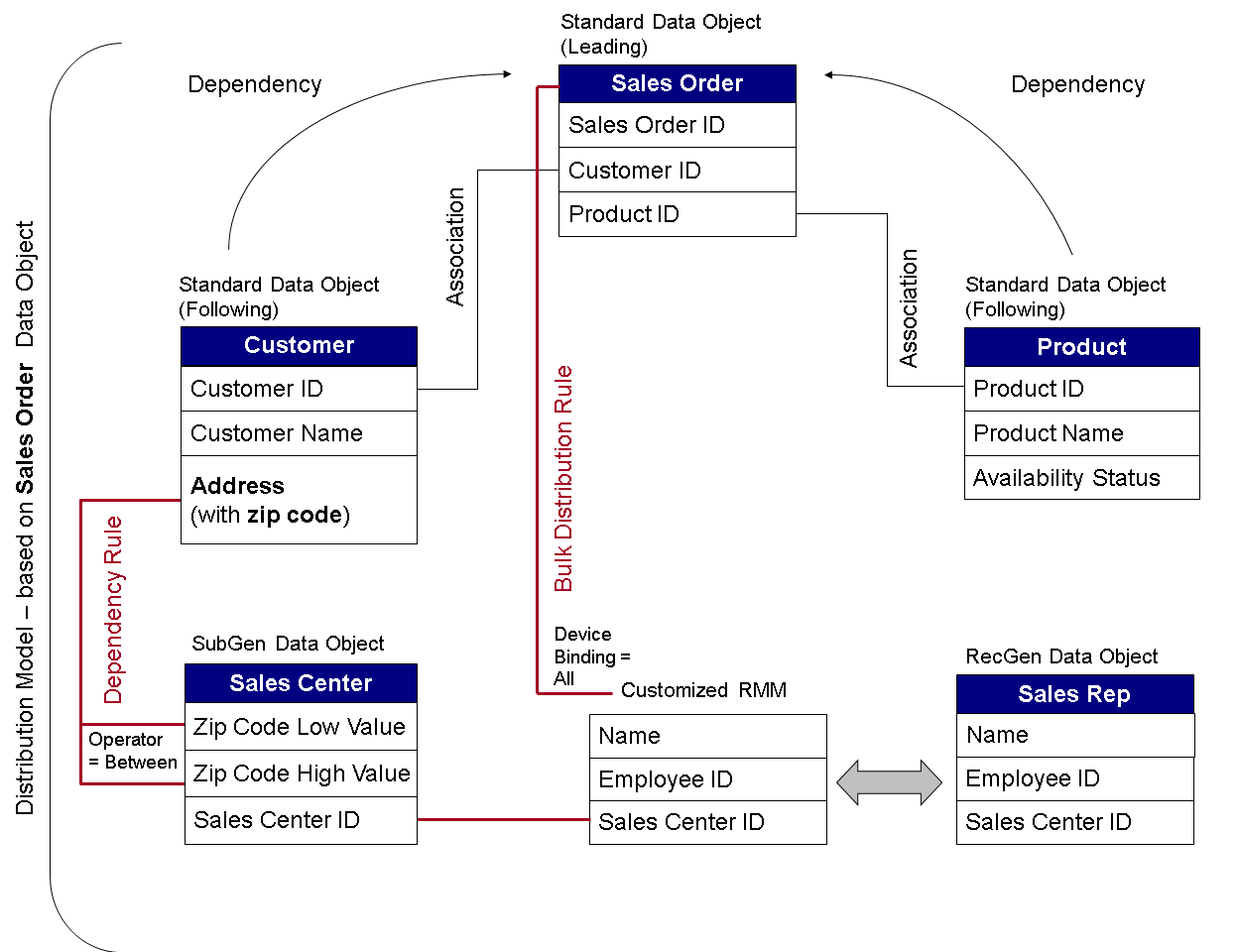
As a result of the solution above, all instances of the Sales Order data object are distributed to all devices. Only the data of the customers associated to the sales orders that are assigned to the relevant sales center based on their zip code are distributed to the devices. In addition, the data of the products ordered in the sales orders are distributed to the devices.
Sample scenario:
-
The company has 1000 customers, 200 of which are assigned to this sales center (based on the zip code)
-
The company sells a portfolio of 100 products
-
There are currently 500 sales orders, 20 of which are assigned to this sales center (based on the zip code)
As a result of the scenario defined above, the sales representatives assigned to the sales center receive the following on their devices:
-
All 500 sales orders
-
A maximum of 200 customer records (theoretically the sales orders could all be for different customers)
-
The records of different products ordered (maximum: 100).
Option 3
Use the following scenario to ensure that devices assigned to a sales center receive the following:
-
All the customers assigned to the sales center based on the zip code.
-
All the existing sales orders for these customers
-
The product data related to the sales orders for these customers
To ensure this, the data and distribution model must match the following requirements:
-
The Customer data object contains the main distribution criterion, the zip code.
-
The distribution model is based on the Customer data object.
-
A distribution rule is defined for the Customer data object using the subscription generation data object for the assignment of the devices.
Two dependencies must be defined for the distribution model:
-
Sales Order data object following the Customer data object
-
Product data object following the Sales Order data object
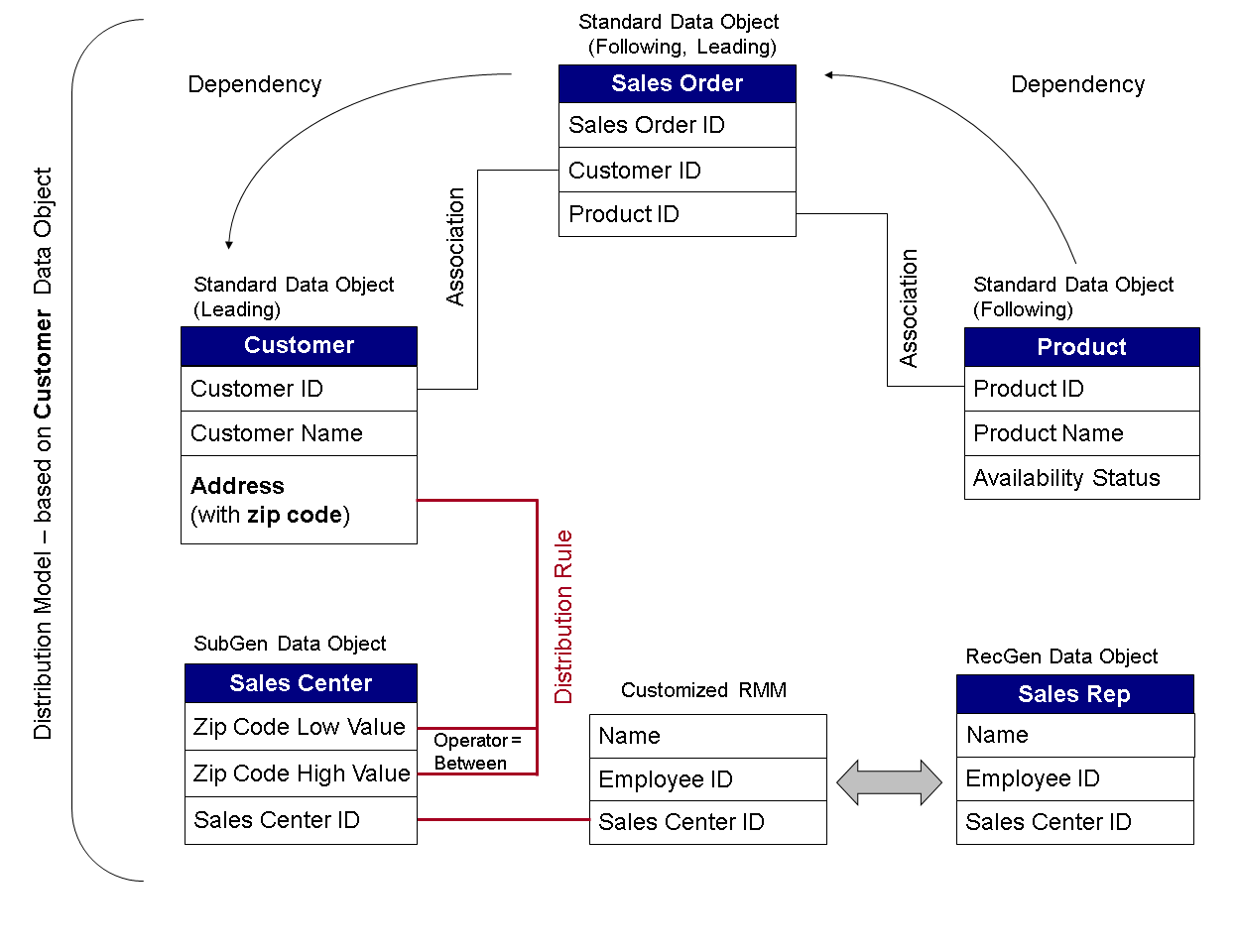
As a result of the solution above, the devices receive all the customers assigned to the sales center. In addition, due to the defined dependencies, they receive all the sales orders of the customers assigned to the sales center and the data about the products they have ordered.
Example
-
The company has 1000 customers, 200 of which are assigned to this sales center (due to the zip code)
-
The company sells a portfolio of 100 products
-
There are currently 20 sales orders for this sales center
As a result of the scenario defined above, the sales representatives assigned to the sales center receive the following on their devices:
-
The data of 200 customers
-
All 20 sales orders
-
The number of records of the different products ordered (maximum 20).
This allows the sales representatives to visit other customers in their area and create sales orders for them. However, they only have the data of the sold products on their devices. This problem is solved by adding another distribution model, as explained in Option 4.
Option 4
Use the following scenario to ensure that devices assigned to a sales center receive the following:
-
All the customers assigned to the sales center based on the zip code
-
All the existing sales orders for these customers
-
The data of all the products sold by the company
To ensure this, the data and distribution model must match the following requirements:
-
The Customer data object contains the main distribution criterion, the zip code.
-
The distribution model is based on the Customer data object.
-
A distribution rule is defined for the Customer data object using the subscription generation data object for the assignment of the devices.
-
A dependency is defined for the distribution model, with the Sales Order data object following the Customer data object
-
An extra distribution model is defined for the Product data object with a bulk rule with device binding ALL for the distribution to the devices.
NoteIn this scenario, the sales representatives also receive all the data of all the products that their company sells, so that they have the all the information they need to create sales orders in the field.
An application can be designed in such a way that the sales representatives can create sales orders in the field. If the client application does not provide a back-end key or the created back-end key is changed by the back end, you must define correlation fields in the Sales Order data object.
More information: Correlation
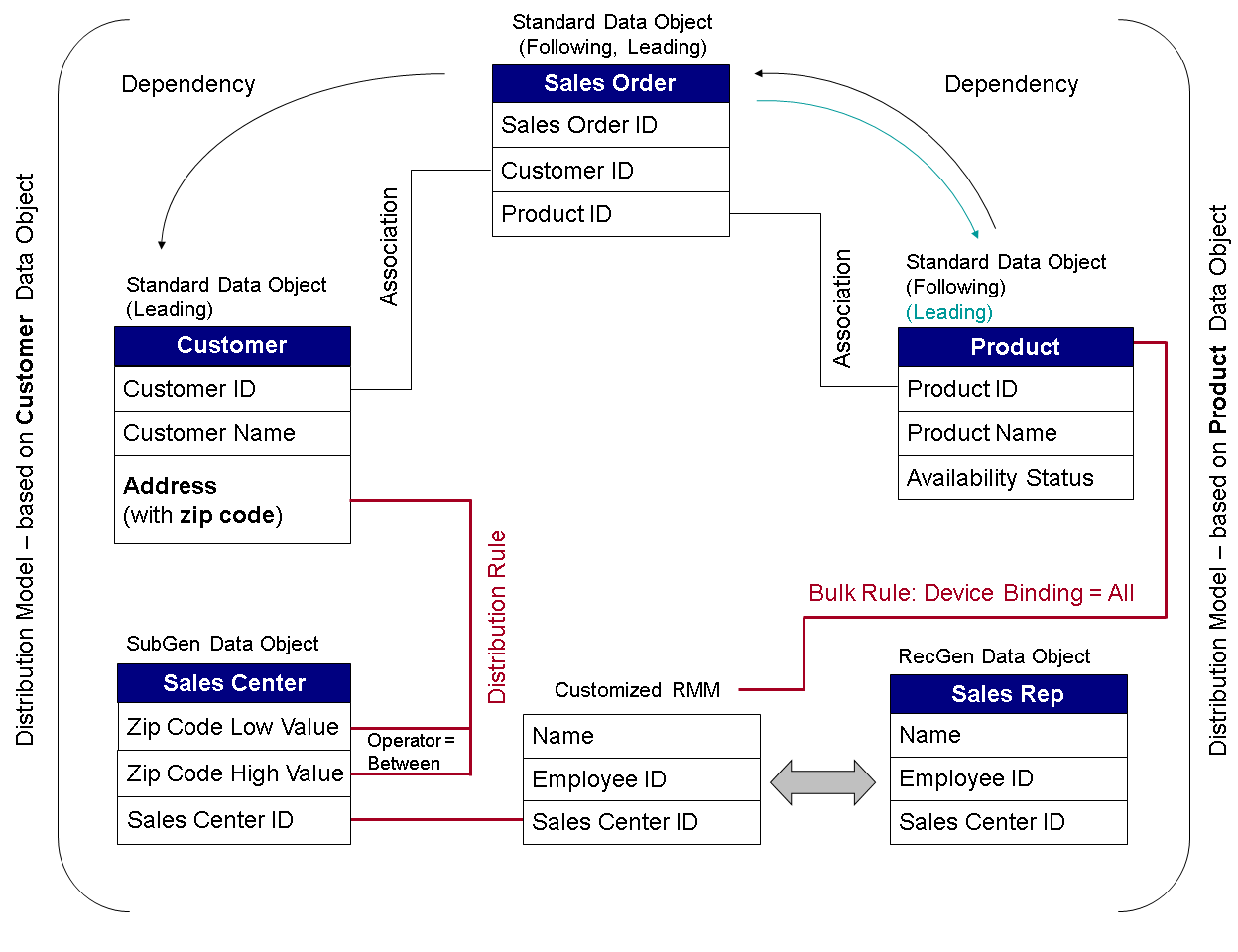
As a result of the solution above, all the devices, independent of the sales center, also receive the data of all the products sold by the company.
Consider a scenario where the company wanted the sales representatives to also receive all the sales orders that existed for a specific product (also of other sales centers). You must then add to the Product distribution model, a dependency between the Sales Order data object and the Product data object. The Product data object should be the leading data object (indicated by the turquoise dependency in figure above).