Query with Two Structures and Ranked-List Conditions
You have defined a query with two structures and now you want to apply conditions with ranked lists to it.
You analyze the net revenue for the product Mousepad in relation to the distribution channels Fax, Internet and Telephone for the calendar year 2003.
The Calendar Year/Month characteristic is located in the rows. The following can be found in the columns:
- Structure 1 with the restricted characteristics Fax and Mousepad, Internet and Mousepad and Telephone and Mousepad.
- Structure 2 with the key figure Net Revenue.
Condition: Top 4 for Internet and Mousepad
You want a query that shows you the four months with the highest revenue in regard to sales of the product Mousepad over the Internet.
Define the following condition:
- When you are defining the condition, choose All Characteristics in Drilldown Independent, under Characteristic Assignment.
- Enter the following condition row:
Choose the key figure Net Revenue, the structure Internet and Mousepad, the operator Top N and enter 4 as the value.
In the query, you only see the rows with the four months with the highest revenue for Internet and Mousepad.
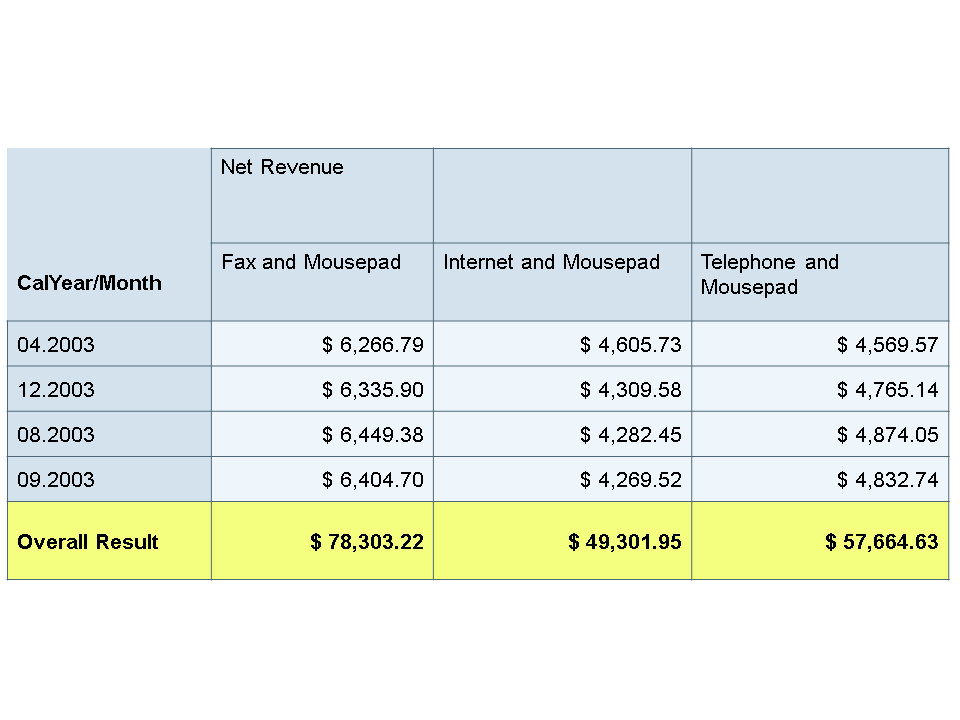
Now you want to determine net revenue by customer and so, in addition to the Calendar Year/Month characteristic, you include the Customer characteristic to the lines of the query.
Condition: Top 3 Combinations of Calendar Year/Month and Customer
You would like a query that shows you the three customer/month combinations that have the highest revenue out of all of the possible combinations of the two.
Define the following condition:
- When you are defining the condition, choose Single Characteristics and Characteristic Combinations, under Characteristic Assignment.
- Select the characteristics CalYear/Month and Customer.
- Enter the following condition row:
Choose the key figure Net Revenue, the structure Internet and Mousepad, the operator Top N and enter 3 as the value.
In the query, you see only the three customer/month combinations with the highest revenue for sales over the Internet:

Ranked list conditions are equally applicable to queries with two structures to those with one structure.