Phases of an Integration Project
Decoupling Business Semantics from Implementation Details
If we assume the different parts of a cross-system business application and their interactions are "hard-coded" on the individual systems that the process spans, then every change at the technical implementation level (such as changing a server address) would entail a change of the whole business process. This is time-consuming, error prone, and does not scale for complex business processes and large system landscapes. Therefore, one basic principle of SAP NetWeaver PI is to decouple the business semantics from the technical details of the concrete system landscape. Business semantics are, for example, the business flow of a process and its separation into individual process components, as well as the structure of exchanged data. These aspects of a business process are merely determined by business considerations rather than by details of the implementation or of the concrete system landscape.
Design Time, Configuration Time, and Runtime
Based on this decoupling, it is possible to describe the integration-relevant aspects of a business process at an abstract level first - irrespective of the details of a particular system landscape. We call the corresponding phase of an integration project the design time. In other words, at design time, you can specify an integration scenario independent from any technical details that are implementation-relevant or system landscape-relevant.
In a later phase - at configuration time - the integration scenario will be configured to run in a specific system landscape. You can consider one and the same integration scenario to be deployed on completely different system landscapes. For example, in one case there is a material management integration scenario that spans only a few systems within a midsize company, whereas in another case the same integration scenario spans several hundreds of systems located in the different departments of a large enterprise. The same scenario in this case involves the execution of the same business logic - just on a different scale. The scenario is finally executed at runtime and can be monitored by an administrator.
The following figure illustrates the relationship of the design time and configuration time view:
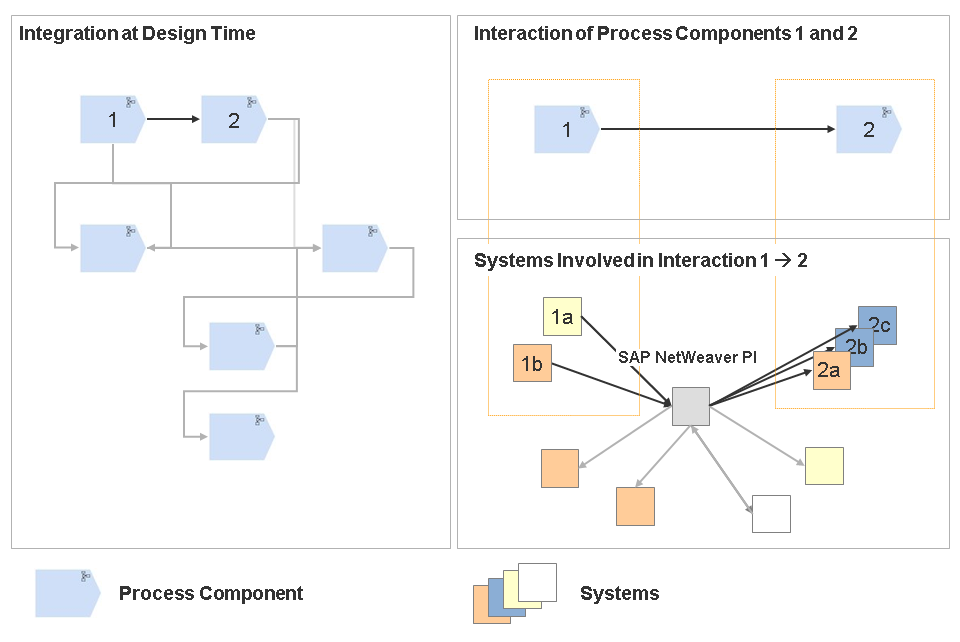
As an example, the figure shows the systems of the actual system landscape where the business logic of process components 1 and 2 is implemented: Process component 1 is deployed on systems 1a and 1b, whereas process component 2 is deployed on systems 2a, 2b, and 2c. Resulting from this, the communication between two process components is broken down to communication between the systems mentioned above at runtime, whereas the communication is mediated by the SAP NetWeaver PI runtime
The three phases introduced here can be considered to be phases of an integration project:
More information: