Getting and Modifying Subobjects of a Main Class
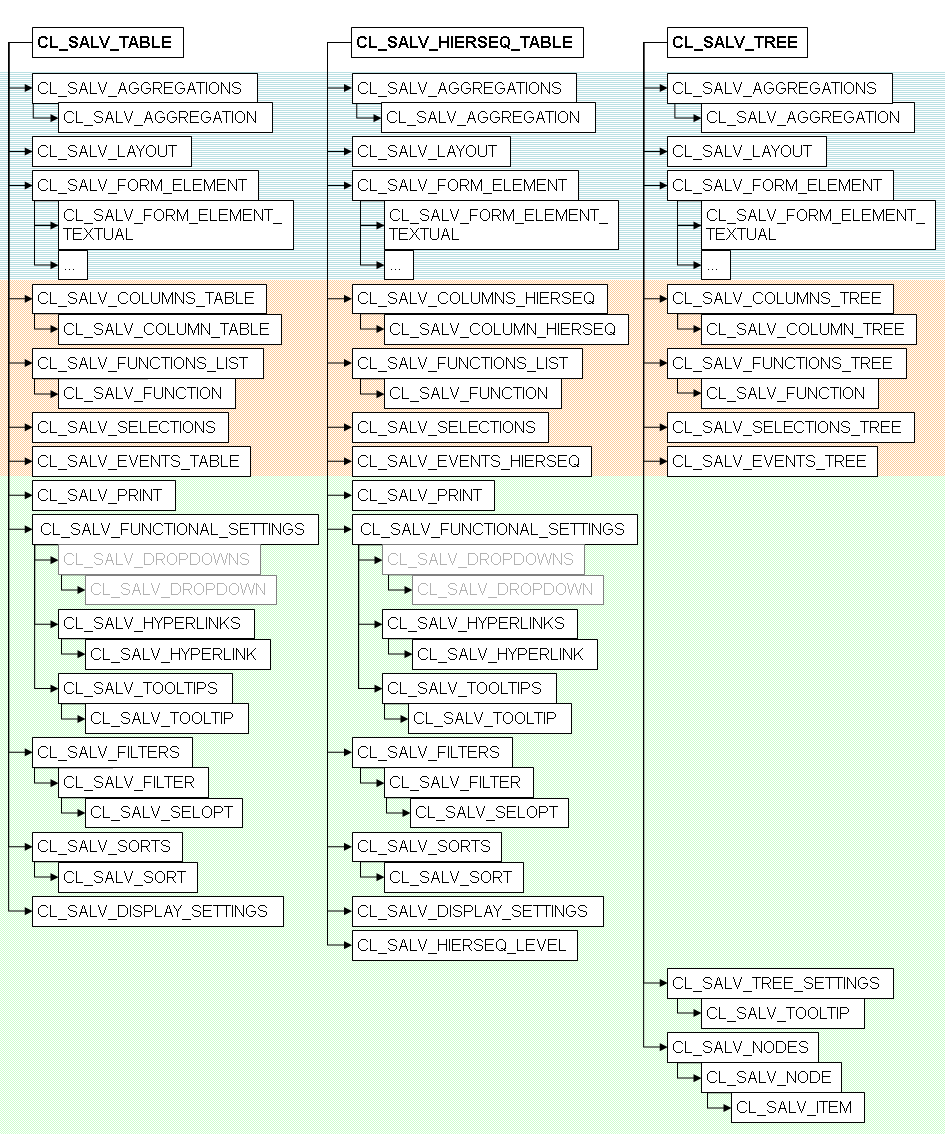
The ALV object model includes a large number of classes that you can use to make specific settings. The following graphic compares the class diagram of the three main ALV classes.
Naming Conventions
The classes of the ALV object model are structured that you can usually tell from the names which areas of the ALV output you can change with the methods from these classes.
-
Singular or plural Often you will find class names that exist in both plural and in singular (such as CL_SALV_COLUMN and CL_SALV_COLUMNS). You can see from the names that in the one class there are methods that only affect a specific object and in the other class the methods are for all of these objects.
-
ALV tool Many functions are available for all three ALV tools. However, when there are differences between the classes of the ALV tools, you can find the right variant by the name (such as CL_SALV_COLUMN_TABLE, _SALV_COLUMN_HIERSEQ, CL_SALV_COLUMN_TREE)
Get Subobjects
You get the objects for these classes using the Get methods of the three main ALV classes. The following table shows which methods in the main ALV classes provide which subobjects:
|
Method |
Returns Object of Type |
Comment |
|
GET_AGGREGATIONS |
CL_SALV_AGGREGATIONS |
|
|
GET_COLUMNS |
CL_SALV_COLUMNS_ TABLE or CL_SALV_COLUMNS_ HIERSEQ or CL_SALV_COLUMNS_ TREE |
|
|
GET_DISPLAY_ SETTINGS |
CL_SALV_DISPLAY_ SETTINGS |
Not in CL_SALV_TREE |
|
GET_EVENT |
CL_SALV_EVENTS_ TABLE or CL_SALV_EVENTS_ HIERSEQ or CL_SALV_EVENTS_ TREE |
|
|
GET_FILTERS |
CL_SALV_FILTERS |
Not in CL_SALV_TREE |
|
GET_FUNCTIONAL_ SETTINGS |
CL_SALV_FUNCTIONAL_ SETTINGS |
Not in CL_SALV_TREE |
|
GET_FUNCTIONS |
CL_SALV_FUNCTIONS_ LIST |
Not in CL_SALV_TREE |
|
CL_SALV_FUNCTIONS_ TREE |
Only in CL_SALV_TREE |
|
|
GET_LAYOUT |
CL_SALV_LAYOUT |
|
|
GET_LEVEL |
CL_SALV_HIERSEQ_ LEVEL |
Only in CL_SALV_HIERSEQ_TABLE |
|
GET_NODES |
CL_SALV_NODES |
Only in CL_SALV_TREE |
|
GET_PRINT |
CL_SALV_PRINT |
Not in CL_SALV_TREE |
|
GET_SELECTIONS |
CL_SALV_SELECTIONS |
Not in CL_SALV_TREE |
|
CL_SALV_SELECTIONS_ TREE |
Only in CL_SALV_TREE |
|
|
GET_SORTS |
CL_SALV_SORTS |
Not in CL_SALV_TREE |
|
GET_TREE_SETTINGS |
CL_SALV_TREE_ SETTINGS |
Only in CL_SALV_TREE |
If one of the classes uses uses another class, you can also get its objects using the Get methods.
|
Class Used |
Includes getter method |
Returns Object of Type |
|---|---|---|
|
CL_SALV_AGGREGATIONS |
GET_AGGREGATION |
CL_SALV_AGGREGATION |
|
CL_SALV_COLUMNS_TABLE |
GET_COLUMN |
CL_SALV_COLUMN |
|
CL_SALV_COLUMNS_ HIERSEQ |
||
|
CL_SALV_COLUMNS_TREE |
||
|
CL_SALV _FUNCTIONAL_ SETTINGS |
GET_DROPDOWNS |
CL_SALV_DROPDOWNS |
|
GET_HYPERLINKS |
CL_SALV_HYPERLINKS |
|
|
GET_TOOLTIPS |
CL_SALV_TOOLTIPS |
|
|
CL_SALV_FUNCTIONS_LIST |
GET_FUNCTIONS |
CL_SALV_FUNCTION |
|
CL_SALV_FUNCTIONS_TREE |
||
|
CL_SALV_FILTERS |
GET_FILTER |
CL_SALV_FILTER |
|
CL_SALV_NODES |
GET_NODE |
CL_SALV_NODE |
|
CL_SALV_SORTS |
GET_SORTS |
CL_SALV_SORT |
If you have created the internal data table and the instance of the ALV main class, you are able to generate an object for each class used and make the settings as well. To do this, you proceed as follows:
-
You declare an object variable for each type of class that you want to use
data: gr_display type ref to cl_salv_display_settings. -
You use the respective Get method the main ALV class to get the objects of the corresponding type
gr_display = gr_table->get_display_settings ( ). -
You use the methods of the class used to assign the desired properties to the object.
gr_display->set_striped_pattern( value = 'X'). gr_display->set_vertical_lines( value = 'X'). -
When you have made the settings you display the ALV output with the display method.