Web UI Technology
Alternatively to the SAP GUI, SAP NetWeaver gives you the option of making applications available using Web-enabled technologies.
In addition to the Internet Transaction Server, which has been used for a few years, Business Server Pages have been used increasingly since the Web Application Servers was introduced to build ABAP-based applications.
Business Server Pages and Web Dynpro: A Comparison
Business Server Pages have a high degree of freedom with respect to application design. Direct programming of HTML means that the application developer can take advantage of all the options of this language. However, this involves a relatively high level of development work. Using the HTMLB library can reduce this work, although it does reduce the developer's freedom in designing the application. Business Server Pages are based on plain HTML and therefore are very definitely platform and device-specific. The model view controller approach is not used so much in Business Server Pages as in the Web Dynpro model.
The Web Dynpro model clearly puts all of its parts into components. This means that the individual components can be easily reused, thereby making application programming considerably simpler. The design options for application developers are, however, considerably fewer than when you create a BSP application. Web Dynpro supports the model view controller paradigm.
Rendering
In the Web Dynpro, all UI elements are described in one location in XML. The appropriate rendering methods for the runtime environment are then generated from this XML description. If a Web Dynpro application should be displayed in the browser, the rendering methods are processed in the server and send exactly the document description language to the client that it can understand. This is usually HTML in the case of a browser.
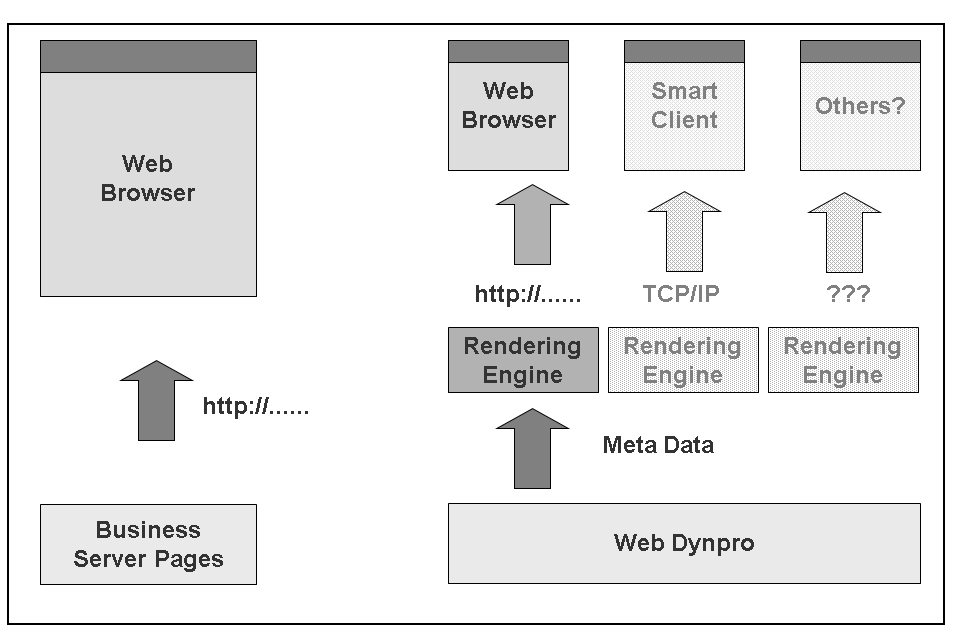
The introduction of this intermediate step leaves the option open for the future to be able to use other clients, which are based on HTML and HTTP, depending on the technical development. A new rendering engine, adjusted accordingly, would have to be developed for this.