Data Completeness Group
Data completeness groups are defined as a group of dependencies between data objects.
Using data completeness groups, you can define that the data of a data object in a distribution model is only to be distributed if all the data to be distributed with it (because of a defined dependency) is complete.
Consider a completeness group that includes the dependency between data object A and data object B. The completeness group ensures that the instances of data object A are only distributed by the DOE if the data related to data object B is also available in the DOE.
You define a dependency as selectable for inclusion in a completeness group by setting the Selectable for Completeness indicator for it.
Not all the dependencies in a dependency scenario that are defined as Selectable for Completeness may be relevant for completeness. To define the selection of dependencies in a distribution model that are relevant for completeness, you create a completeness group and include the relevant dependencies in it.
-
You can have several data completeness groups in a distribution model. Any data object that is part of a completeness-relevant dependency can only belong to one completeness group. This means that different completeness groups cannot share the same data object.
-
You can include dependencies from multiple different distribution models in the same software component version (SWCV).
-
You should avoid to create highly complex completeness groups with a large number of data objects as this has an impact on performance.
Example
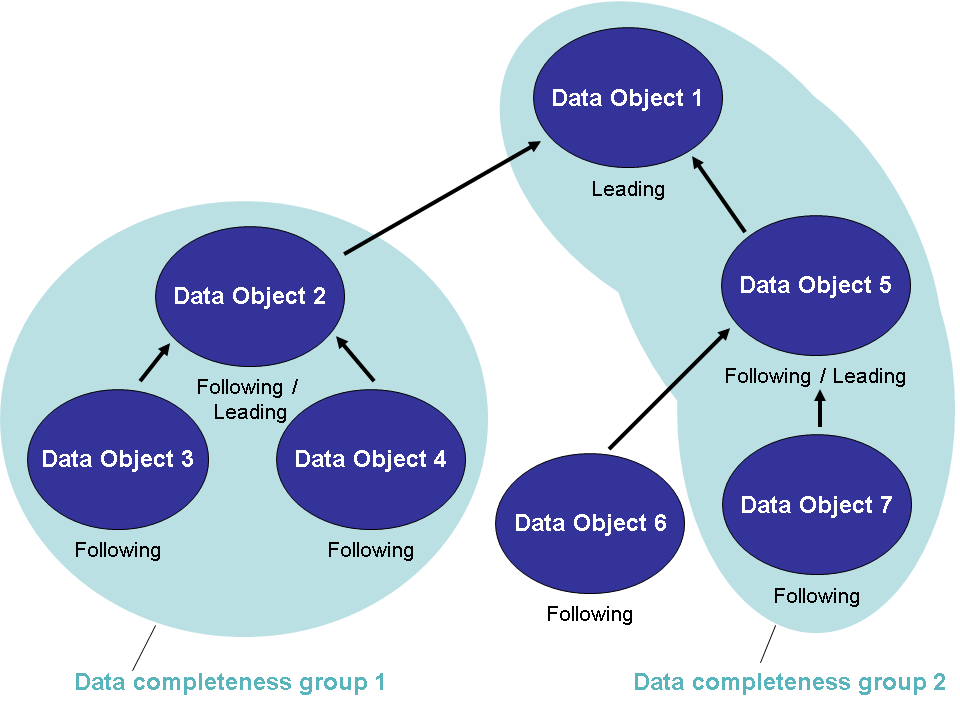
In the scenario above, data completeness group 1 defines that instances of the data objects 2, 3 and 4 are only to be distributed if the data of all these data objects is present in the DOE. So instances of data object 2 only follow instances of data object 1 if this requirement is met. Instances of data object 1 however are distributed by the DOE whether the data of data object 2, 3 or 4 is available for distribution or not.
Data completeness group 2 defines that instances of the data objects 1, 5 and 7 are only to be distributed if the data of all of these data objects are also available for distribution. Since data object 6 is not part of any completeness group, instances of data object 5 are distributed by the DOE whether the data of data object 6 is available or not.