Data Object Categories
A data object category defines a default flow definition for a data object. When you create a data object, you choose the data object category you want to serve as its template. The newly created data object inherits the flow definition from the selected data object category. A flow definition is made up of flow blueprints. Each flow blueprint specifies a sequence of services, which perform processing on the data contained in the data object. A flow blueprint represents a logical, elementary segment of processing.
Five data object categories are provided by Data Orchestration Engine (DOE) design tools. The most important category for application developers is Standard. The data object categories are listed here with a summary of their purpose.
-
Standard
Standard data objects are used to transfer data from the DOE to mobile clients and from mobile clients to the DOE. This is the primary data object category application developers use.
-
Subscription Generation
Subscription generation (SubGen) data objects are used to create subscriptions for data to be extracted from the back end. Here the metadata, that is the data used to create the subscription, is not required by the mobile device and is transferred from the back end to the DOE only. This could be, for example, employee data that is used to subscribe to specific employee-related information from the back-end system that is then distributed to the devices. The employee data itself, however, is not required on the devices and remains in the DOE.
The use of a SubGen data object in a project is optional.
-
Device Local
This data object category is used to process data used exclusively by the application user interface on the mobile client.
The use of a device local data object in a project is optional.
-
Receiver Generation
Receiver generation (RecGen) data objects are used to generate the logical devices for the mobile clients for the purposes of distributing data to the appropriate subscribers. The fields defined in the receiver generation data object define the information to be extracted from the back end for storage in the device inventory. These fields are mapped to receiver meta model fields.
The use of a RecGen data object in a project is optional.
-
Hierarchy Generation
You can represent your organization hierarchy by using a hierarchy group. This ensures easy administration of your system landscape. A hierarchy group is a tree structure that consists of nodes at the different levels. Consider the following hierarchy group:
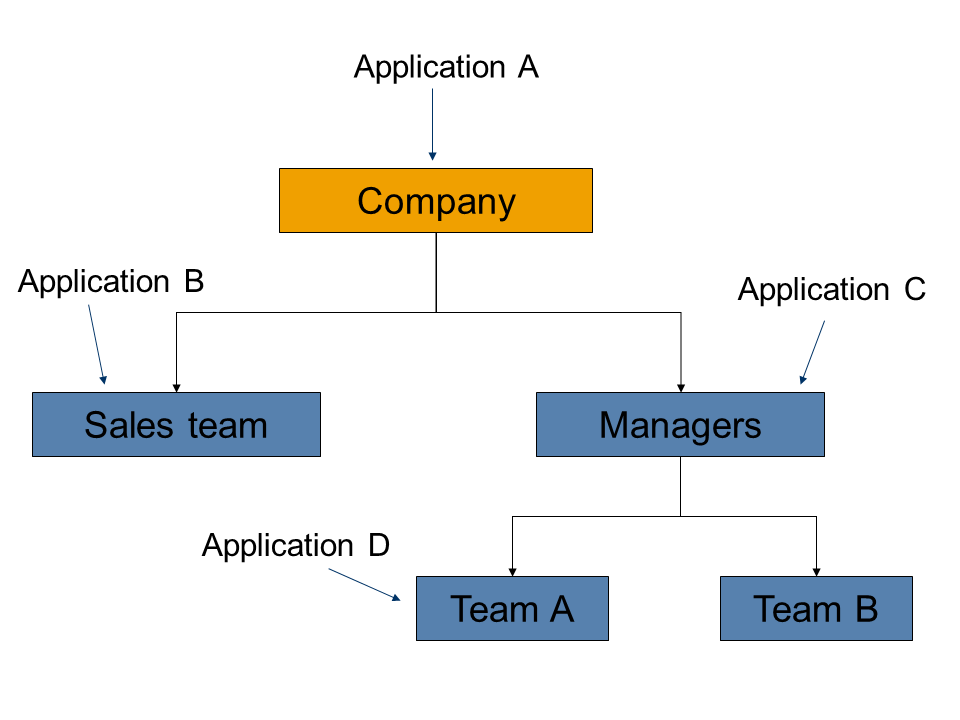
If a hierarchy generation data object is created from this hierarchy group, and applications are assigned to the nodes, the assignment is as follows:
-
Application A is assigned to all the members of the company.
-
Application B is available only to the Sales team
-
Application C is available to managers, team A, and team B.
-
Application D is available to only team A.
You can either create a hierarchy group in the DOE for managing the SAP NetWeaver Mobile landscape or use a hierarchy group available in the back end. The hierarchy group in the back end can be imported as a hierarchy generation data object.