 Commodity OTC Options
A commodity OTC option is a special kind of OTC option that has an underlying commodity forward. In the case of OTC options, the buyer of an option has a right but not an obligation to buy or sell the underlying commodity at a fixed price called the “strike price”.
All options have an expiry date that defines the period during which the right has to be exercised.
A put is an option to sell at fixed price. The buyer of a put has the right to sell the underlying commodity.
A call is an option to buy at a fixed price. The buyer of a call has the right to buy the underlying commodity.
You can calculate the net present value as well as the clean price of options on commodity forward deals.
 Note
Note
Important factors to note in this section are:
The Market Risk Analyzer can calculate the net present value of European options on commodity forwards using the Merton model.
American options use the Broadie and Detemple BBSR model.
The system calculates additional cash flows, such as fees or premiums.
Forward prices are taken from the commodity curve.
Volatility is maintained.
Note
This function is available with the business function TRM, Financial Risk Management for Commodities (FIN_TRM_COMM_RM).
Features
The Market Risk Analyzer can calculate the net present value of available options on commodity forwards. OTC commodity options can only be calculated if the horizon is before the maturity of the option and if the maturity of the option is before the maturity of the underlying forward.
The price calculator calculates the net present value of existing options on commodity forwards using the formulae shown here.
For call options:

For put options:

Where d1 and d2 are calculated using the following formulae:

Legend:

Greeks
The Greeks measure the sensitivity of the option to certain key factor changes. The Greeks options are as follows:
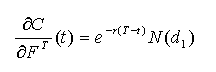
Delta
Measures the rate of change of option value with regard to the underlying commodity forward price.
Call
Put

Gamma
Gamma is the second derivative regarding the underlying price.
Call

Put

Theta
Measures the sensitivity of the value of the option over time.
Call

Put

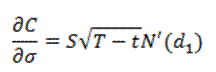
Vega
Vega measures the volatility of the underlying commodity forward.
Call
Put

Activities
To calculate and view the NPV for a commodity OTC option, choose  Financial Risk Management for Commodities
  Accounting Valuation TPM60 – Determine Net Present Values
  and proceed as follows:
Set the OTC Transactions indicator in the Product Groups section.
Select a product type for commodity OTC options.
Make any other selections in this screen, for example, Company Code or Transaction Type.
Select your evaluation parameters.
Choose Execute.
A list of NPVs that meet your selection criteria is displayed.
Note
You can also calculate NPVs by entering the commodity OTC option characteristics in the NPV Analysis screen: Financial Risk Management for Commodities Analytics Mark-to-Market & Sensitivities JBRX – NPV Analysis