 Options on Bonds (OTC)
Use
The market price calculator for options on bonds calculates current market values, time values, and future market values (the future point in time is the horizon).
Options on bonds have two variants, call and put. At the moment, only the European type can be dealt with. The buyer can either buy (call) or sell (put) a bond on a particular date at an agreed-upon strike price (clean price of the bond in the issuing currency). Only options whose horizon is before the expiration date are valued.
In valuing the option, the NPV of the cash flow (interest and principal) from the underlying after the expiration date is calculated, is used to determine the theoretical price of the option on the expiration date. After deducting accrued interest, the theoretical clean price of the bond goes into the option price formula (Black-Scholes) as the spot, along with the strike price, term, risk free interest rate, and the price volatility. You can either enter the price volatility of the (forward) bond price yourself, or it can be calculated for you using the duration and yield taken from the interest volatility.
Integration / Calculation Basis
In order to value bond options, you need the transaction data, and alternatively a par coupon or zero coupon yield curve in the transaction currency for the evaluation date. In addition to the yield curves necessary for discounting generated cash flows (see input parameters), it is possible that additional yield curves are needed to calculate forward interest rates for variable interest payments.
In addition, you need a price volatility curve for the bond in the underlying over the term of the option. If this is not available, you can use an interest volatility curve for the term of the option. The reference interest rate you give is the one closest to the reference interest rate in the yield curve, whose term most closely parallels that of the bond. For example, if the term of the fixed side of the swap is 4.25 years, the term for the reference interest rate in a yield curve has to be set to four years.
Depending on the calculation procedure, the following input parameters are calculated for later determining the risk free interest rate and the spot rate (both of which go into the price formula):
Zero coupon rates and zero bond discounting factors which are calculated using the zero and par coupon calculation methods.
If the underlying bond contains more than one currency when determining the spot rate, the currencies are converted into the call or put currency using the appropriate currency rates. If the horizon is later than the evaluation date, the corresponding forward currency rate is calculated for the horizon using the yield curve from the transaction currency on the evaluation date.
Spot
The spot is the NPV of the clean price (standardized to the nominal volume) of the bond on the expiration date of the option. Using the Treasury Management component, a cash flow is generated when a bond is created. The payment flow consists of principal and interest payments, which flow on particular dates, and are standardized to a nominal amount of 100,000. The amount of the interest payments is known for fixed interest rates. For variable interest rates, only the reference interest rate is known. It is calculated gradually using the forward calculator. For interest rate agreements whose fixed and variable interest rates are tied to formulae, the amount of the resulting interest rates is calculated using the calculated forward rates (possibly taking interest floors and caps into consideration). The extent of the resulting interest payments is also determined. On the one hand, payment flows are reduced by those cash flows whose due date is before the expiration date of the option. On the other hand, they are increased by the cash flows from the accrued interest, which is calculated using the accrued interest calculator. The cash flow from the accrued interest continues until the expiration date of the option. The NPV of the individual cash flows is calculated on the horizon according either to the par or zero coupon calculation methods. This is done using the yield curves, dependent on the transaction currency. It is the equivalent of the NPV of the individual cash flows first on the expiration date of the option, and again on the horizon. The value of the spot is the NPV of the sum of the cash flows, which have been changed into the transaction currency of the call or put price, using forward currency rates. The sum is standardized to the nominal volume of the bond
The following abbreviations/definitions are used:
t i : |
Expiration date of the cash flow |
C i : |
Cash flow at time point t i (including accrued interest payments) |
BW(C i ): |
Net present value on the horizon of the cash flow due on t i |
W i : |
Currency of cash flow C i |
W k : |
Currency of the call or put rate (issuing currency) |
NV: |
Nominal volume of the bond = 100,000 |
WK(W i ;W k ): |
(Forward) currency rate (ask or bid) W i /W k on the horizon |
NPV: |
Market value |
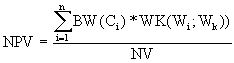 ( )
( )
Volatility
If a price volatility curve is available, then the volatility which goes into the option price formula is the one from the curve with a validity period the same as the one representative of the difference between the expiration date of the option and the horizon.
If no price volatility curve is available, the interest volatility is determined for the term according to the difference between the expiration date and horizon of the option (possibly linearly interpolated from the values of neighboring option terms). The price volatility calculator then converts it to a price volatility using the modified duration (based on the interest and principal payment flows from the bond after the expiration date of the option), and the forward zero yield. The yield is calculated from the given zero bond discounting factors and, is calculated for the remainder of the term of the bond (in relation to the expiration date of the option).
If the transaction currency differs from the display currency of the option (or the currency of the call or put sides), the transaction currency is changed into the display currency using the currency rate from the horizon. If the horizon is later than the evaluation date, the corresponding forward currency rate is calculated for the horizon using the yield curves from the transaction and display currencies from the evaluation date.
The following function modules are used to calculate the input parameters:
Scope of Functions / Valuation
The option price calculator uses the following parameters (some of which are taken from the input parameters) when pricing European options (Black-Scholes formula):
Call/Put: |
Call/Put |
Term: |
Term of the option in days (expiration date of the option to the horizon) |
Spot: |
See input parameters |
Strike: |
Agreed call or put price of the security standardized to 1 |
Interest rate 1: |
0 (no forex option) |
Interest rate 2: |
Risk-free interest rate = zero interest rate of the interest yield curve with a term equivalent to the option term. |
Volatility: |
See input parameters |
The difference (DZ) between the price of the bond and its call or put price on the expiration date of the option is standardized to the nominal volume of the bond, with a lower limit of zero. The NPV of the simulated DZ is then calculated.
The net present value of the interest option is the nominal volume (NV) multiplied by the interest difference DZ.
Along with the symbols given already, the following are also used:
 ( )
( )
where:
K: |
Call/put indicator |
If the display currency differs from the issuing currency (that is, the currency of the call or put price), the NPV is calculated using the forward currency rate.