 Forward Rate Agreements (OTC)
Use
The market price calculator for forward rate agreements (FRAs) calculates current market values, time values, and future market values (where future means the horizon).
An FRA is a means of hedging against rising or falling interest rates by agreeing an interest rate now to apply at a future date. This interest rate is compared to a reference interest rate R k (for example the LIBOR for a given period) when the contract is being made.
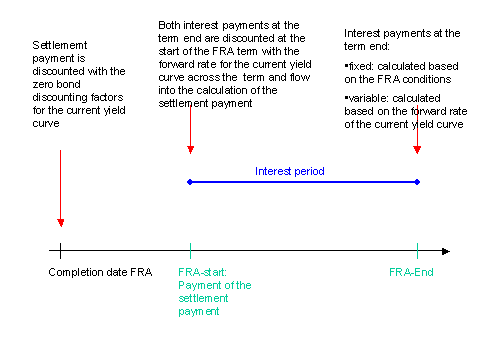
The settlement payment is due on the settlement date (the beginning of the hedge period). The settlement payment is calculated by taking the nominal sum from the difference between the contract and actual interest rates on the fixing date (normally two days before the settlement date). This amount is then discounted from the end of the hedge period (using the forward rate) back to the fixing date.
The NPV of the FRA depends on the position of the horizon. If it is before the settlement date, then the NPV is calculated on the horizon (back from the end of the hedge period). If the horizon is after the settlement date, then the NPV is zero.
Integration / Calculation Basis
Depending on the positioning of the evaluation date and the horizon, the following parameters must be used.
Evaluation datehorizon < fixing date < settlement date or evaluation date < fixing date < horizon < settlement date
In order to value a future, the transaction data, and alternatively a par coupon or zero coupon yield curve in the transaction currency, has to be entered for the evaluation date. In addition to the yield curve structure necessary for discounting generated cash flows (see initial parameters), a yield curve structure is also necessary to calculate forward rates for variable interest payments.
Fixing date < evaluation date £ horizon < settlement date
In order to value a future, the transaction data, and alternatively a par coupon or zero coupon yield curve in the transaction currency, has to be entered for the evaluation date. In addition, you also need the interest rate R f for the reference interest rate on the fixing date. If this value is not available, the value of the interest rate is set at zero.
Fixing date < settlement date < horizon
No information required.
Zero bond discounting factors are needed as further input parameters in order to discount the payments. The zero and par coupon calculation methods can be used to define the zero bond discounting factors.
If the transaction currency differs from the display currency of the FRA, the transaction currency is translated into the display currency using the currency rate at the horizon. If the horizon is later than the evaluation date, the corresponding forward currency rate (bid or ask price) is calculated for the evaluation date using the yield curves from the transaction and display currencies.
The following procedures are used to calculate the input parameters:
Scope of Functions / Valuation
Depending on the positioning of the evaluation date and the horizon, the NPV of the FRA is calculated as follows:
Evaluation date £ horizon < fixing date < settlement date or evaluation date < fixing date < horizon < settlement date
First, the forward interest rate of the reference interest rate is calculated. The interest payments calculated from this are put into the cash flow, which as a consequence only contains flows the size and payment date of which are certain. Depending on the method of calculation (par or zero coupon method), the NPV of the individual cash flows is calculated (see input parameters) using the yield curve (appropriate to the transaction currency) from the settlement date of the FRA. The value of the FRA settlement payment (in transaction currency) is the difference between the NPVs of the two cash flows.
The following abbreviations/definitions are used:
C:
Cash flow resulting from the agreed interest rate of the FRA
D:
Cash flow resulting from the forward reference interest rate
BW(C/D):
NPV of cash flows C & D on the settlement date
K:
Long/short indicator
AZ:
Settlement payment
 ( )
( )
Hence the NPV of the FRA is the NPV of the settlement payment on the horizon, corresponding to which method of calculation is used (par or zero coupon method).
If the display currency differs from the transaction currency, the NPV is calculated using the forward currency rate.
 ( )
( )
Fixing date < evaluation date £ horizon < settlement date
The cash flow in this case only contains payments the amount and payment date of which are known. Depending on the method of calculation (par or zero coupon method), the NPV of the individual cash flows is calculated (see input parameters) using the yield curve (appropriate to the transaction currency) from the settlement date of the FRA. The value of the FRA settlement payment (in transaction currency) is the difference between the NPVs of the two cash flows.
The following abbreviations/definitions are used:
C:
Cash flow resulting from the agreed interest rate of the FRA
D:
Cash flow resulting from the fixed forward reference interest rate
BW(C/D):
NPV of cash flows C & D at the end of the lead time.
K:
Long/short indicator
AZ:
Settlement payment
( )
Hence the NPV of the FRA is the NPV of the settlement payment on the horizon, corresponding to which method of calculation is used (par or zero coupon method).
If the display currency differs from the transaction currency, the NPV is calculated using the forward currency rate.
Fixing date < settlement date < horizon
The net present value of the forward rate agreement is zero.