General European Standard Options
This function prices European options on stocks, bonds, indexes, and call options and repayment options.
Features
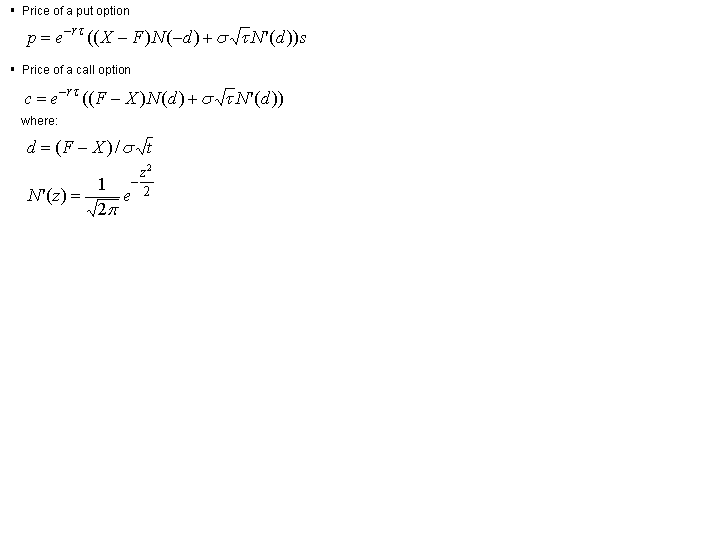
Black-Scholes
The system uses the Black-Scholes formula to price options. The formula is slightly different for each type of underlying. The method used to price stock or bond options is used as a basis for pricing the other options.
The calculation formula is considered only in cases where the horizon lies between the purchase or sale of the option and its expiry date. In all other cases, the value of the option is zero.
Stock or Bond Options
The cS(tH, tE, T, X) value of a call option and the pS(tH, tE, T, X) value of a put option are calculated as follows:
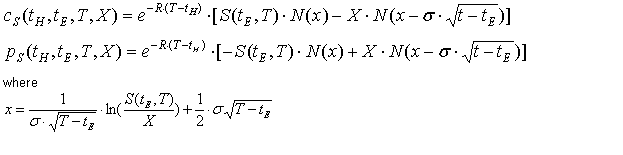
where tH is the horizon, tE the evaluation date, T the expiry date of the option, X the strike of the option, R the risk-free forward interest rate on evaluation date tE for the period from horizon date tH to expiry date T, σ the volatility of the underlying for the time period from tE to T, and N(x) the standard normal distribution; S(tE,T) is the forward spot price of the underlying:

where r is the risk-free interest rate for the period from evaluation date tE to expiry date T of the option; q is the relevant dividend yield.
The Black-Scholes formula uses interest rates based on continuous compounding using interest calculation method act/365.
Index Options
Index options are treated in the same way as stock options. The index value is used as the spot price.
Currency Options
Currency options are treated in the same way as stock options. The exchange rate is used as the spot price. The risk-free interest rate is calculated as the difference between the interest rate of the local currency and the interest rate of the foreign currency.
Call Options and Unscheduled Repayment Options for Loans
Call options and unscheduled repayment options for loans are treated as call options (bond options) on loans. They are always short positions. For technical reasons, the pricing model prices only loans with precisely one call option and unscheduled repayment option correctly.
Swaptions
A swaption is an option on an interest rate swap that involves a fixed and variable leg. The buyer of the swaption gains the right to enter into a swap on a specified future date. The pricing model can price swaptions as interest rate options or as bond options.
Price swaptions as bond options
The system calculates the NPV of the swaption as an option on a fixed-rate bond where the option is exercised when the value of the fixed-rate bond is exceeds the value of the relevant variable-rate bond. The bond here is described by the fixed leg of the swap. The system uses the interest rate volatility and Macaulay duration to calculate the price volatility of the swaption (meaning the price volatility of the fixed leg). To determine the Macaulay duration, the price calculator calls up the cash flow discounting pricing model.
Price swaptions as interest rate options
The system calculates the NPV of the swaption as for that an option on a reference interest rate. The swap rate is used as the interest rate. The swap rate is calculated as the fair interest rate for a bond that corresponds to the fixed leg of the swap. The interest rate of the fixed leg of the swap is used as the strike.
Normal Distribution Model for Interest Rate Options
You can price some options (swaptions, caps/floors, and interest rate guarantees) using the normal distribution model.
The Black-Scholes model is based on the assumption that the values of the underlying are greater than zero. Since this is not always the case when interest rates are the underlying, market data providers also offer volatilities that, instead of applying the Black-Scholes model, use the normal distribution model, that is, the volatilities are not relative volatilities (%) but absolute volatilities in units of the underlying (% in the sense of an interest rate).
The normal distribution model uses the following formulas: