 Account Transactions
Use
The market price calculator for money market transactions calculates current market values, time values, and future market values (the future point in time is the horizon) on the basis of a due-scenario and simulated interest payments .
Both asset and liability accounts can be held. An account is defined by a currency and an account number. The validity of the conditions can be limited to a certain time period and assigned a particular interest calculation method. When valuing, the conditions valid on the evaluation date are taken into account. Only the product interest rate is needed for the gap analysis. Revenues and balances can be kept according to value or booking date.
In the first step, revenues are added to the balance. By creating a "due scenario", "fictional" balance flows (with a distinction between asset and liability balances) can be simulated for each account. If a due scenario is missing, it is assumed that the balance flows take place directly on the evaluation date. The interest rate cash flows are calculated for the simulated interest payments according to the Customizing settings.
Integration / Calculation Basis
In order to value an account when the Customizing settings prescribe a "due scenario", then alternatively a par coupon or zero coupon yield curve in the transaction currency, has to be entered for the evaluation date.
If the display currency for an evaluation is different from the transaction currency of the account, the relevant currency rate is needed. If the horizon comes after the evaluation date and the transaction currency differs from the display currency, you need to enter a par or zero coupon yield curve to calculate a forward transaction on the horizon.
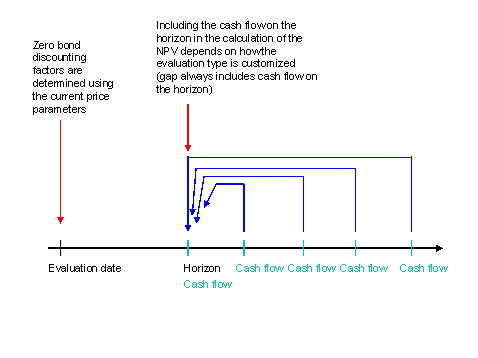
Zero bond discounting factors are needed as further input parameters in order to discount the cash flow. Only the zero coupon calculation method can be used to define zero bond discounting factors.
If a "due scenario" is missing, no calculation basis is needed.
Scope of Functions / Valuation
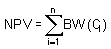
If a cash flow was generated in accordance with a "due scenario", it only contains flows whose payment date and value are known (time-wise, they are all either on or after the evaluation day). The first step reduces the cash flow to those flows which have due dates later than the horizon. Depending on the method of calculation (par or zero coupon method), the NPV of the individual payments is calculated for the horizon, using the yield curve of the transaction currency. The value of the account (in the transaction currency) is the sum of the NPVs of the cash flows.
 ( )
( )
The following abbreviations/definitions are used:
t i : |
Expiration date of the cash flow (i = 1,..n) |
C i : |
Cash flow at time t i |
BW(C i ): |
Net present value on the horizon of the cash flow C i due on t i |
NPV: |
Net present value |
 ( )
( )
If the display currency differs from the transaction currency, the NPV is calculated using the forward currency rate.