 Money Market Transactions
Use
Money market transactions are fixed-term deposits and transactions with commercial papers .
The market price calculator for money market transactions calculates current market values, time values, and future market values (the future point in time is the horizon).
Fixed term deposits can be created both as investments (asset-side transactions), or as money raised (liability-side transactions). Both the maturity term as well as the beginning of the maturity term can be set so that they are variable. For fixed interest rate agreements, the frequency of the interest payments can be individually determined. You can also process several fixed interest rates for different interest periods.
Commercial papers are created like fixed term deposits, with a period (term) beginning and end. In contrast to fixed term deposits, interest is only paid at maturity . The nominal amount is the entire payment at the end, made up of the principal and interest payments combined. Thus, the nominal volume (= principal payment) is smaller than the nominal amount. As an alternative to an interest rate, a purchase or sale price can also be set up. This means that commercial papers can be handled and valuated as zero bonds.
Integration / Calculation Basis
In order to value a fixed term deposit, the transaction data, and alternatively a par coupon or zero coupon yield curve in the transaction currency, has to be entered for the evaluation date.
With the help of the Treasury Management component, a cash flow is generated when a money market transaction is created. The cash flow consists of interest payments, which "flow" at particular points in time, and a principal payment. Because the fixed interest rates are given, the all interest payments are known.
Zero bond discounting factors are needed as further input parameters in order to discount the cash flow. The zero and par coupon calculation methods can be used to define the zero bond discounting factors.
If the transaction currency differs from the display currency of the money market transaction, the transaction currency is changed into the display currency using the currency rate from the horizon. If the horizon is later than the evaluation date, the corresponding forward currency rate is calculated for the evaluation date using the yield curves from the transaction and display currencies.
The following function modules, among other things, are used in calculating the input parameters:
Scope of Functions / Valuation
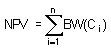
In the first step, the cash flow is reduced to those flows which have due dates later than the horizon. Depending on the method of calculation (par or zero coupon method), the NPV of the individual payments is calculated for the horizon, using the yield curve of the transaction currency. The value of the money market transaction (in the transaction currency) is the sum of the NPVs of the cash flows.
The following abbreviations/definitions are used:
t i : |
Expiration date of the cash flow (i = 1,..n) |
C i : |
Cash flow at time t i |
BW(C i ): |
Net present value on the horizon of the cash flow C i due on t i |
NPV: |
Net present value |
 ( )
( )
If the display currency differs from the transaction currency, the NPV is calculated using the forward currency rate.