 Loan Transactions
Use
The market price calculator for loan transactions calculates current market values, time values, and future market values (the future point in time is the horizon).
Both loans taken and loans given can be valued. Both fixed and variable interest rate agreements can be set up and valued. Principal repayment can be set up and valued using full payment at maturity, payment in installments, or annuity payments. Premiums and discounts can also be taken into account. A differentiation is also made between disbursed and non-disbursed loans.
Integration / Calculation Basis
In order to value a loan, the transaction data, or alternatively a par coupon or zero coupon yield curve in the transaction currency (ask or bid rate), has to be entered for the evaluation date. In addition to the yield curve structure needed for discounting generated cash flows (see initial parameters), it may be that a yield curve structure is also needed to calculate forward rates for variable interest payments.
With the help of the Treasury Management component, a cash flow is generated when a loan is created. The cash flow consists of interest and principal payments, which "flow" at particular points in time. The amount of the interest payments is known for fixed interest rates. For variable interest rates, only the reference interest rate is known. For disbursed loans, the cash flows are reported according to the Customizing settings and summarization rules.
Zero bond discounting factors are needed as further input parameters in order to discount the cash flow. The zero and par coupon calculation methods are available for defining zero bond discounting factors.
If the transaction currency differs from the display currency, the transaction currency is changed into the display currency using the currency rate (ask or bid rate) from the horizon. If the horizon is later than the evaluation date, the corresponding forward currency rate (bid or ask price) is calculated for the evaluation date using the yield curves from the transaction and display currencies.
In calculating the input parameters, the following function modules, among other things, are used:
Scope of Functions / Valuation
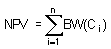
In the first step, the cash flow is reduced to those flows which have due dates later than the horizon. For loans with variable interest rates, a further step calculates the forward interest rates for the reference rates. The calculated interest payments are put into the cash flow, which only contains flows whose size and payment date are certain. Depending on the method of calculation (par or zero coupon method), the NPV of the individual payments is calculated for the horizon, using the yield curve of the transaction currency. The value of the loan (in the transaction currency) is the sum of the NPVs of the cash flows.
The following abbreviations/definitions are used:
t i : |
Expiration date of the cash flow (i = 1,..n) |
C i : |
Cash flow at time t i |
BW(C i ): |
Net present value on the horizon of the cash flow C i due on t i |
NPV: |
Net present value |
 ( )
( )
If the display currency differs from the transaction currency, the NPV is calculated using the forward currency rate.