 Example: Check Logic for Revenues Cover Pool
Initial situation
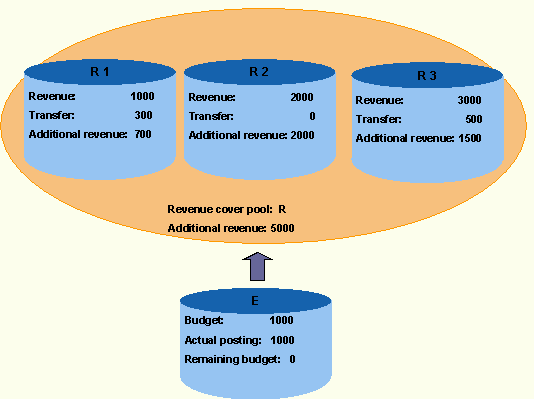
Revenues FM account assignments R1, R2, and R3 are grouped together in revenues cover pool R. Expenditures account assignment E is assigned to revenues cover pool R.
For revenues cover pools R, you have defined in the rules for revenues increasing the budget that all revenues less than or equal to 5000 should be made available as additional revenues.
Expenditures account assignment E originally had a budget of 1000, however, it has used the full amount.
The graphic illustrates the information described in this section:
Cover relationship between revenues cover pool R and expenditures account assignment E
 ( )
( )
Actual posting of 3500 to expenditures account assignment E
A posting of 3500 is made to expenditures account assignment E. The program first checks the available budget and determines that budget is no longer available in the account assignment itself. The system then checks whether the account assignment is entitled to cover. As the account assignment has been assigned to revenues cover pool R, which has available additional revenues of 5000, the posting is allowed. The program consequently divides the cross assignments between the members of the revenues cover pool.
The result of this posting is depicted in this graphic:
Result of actual posting to expenditures account assignment E
 ( )
( )
Manual budget transfer of additional revenues of 800 from R1 to E
As only 700 in additional revenues is available in account assignment R1, the program goes to the budget transfer posting. In this case, the program does not evaluate revenues cover pool R.
This is depicted in the following graphic:
Result of check on manual budget transfer from additional revenues to R1
 ( )
( )
Manual budget transfer of additional revenues of 100 from R1 to E
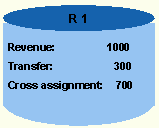
Once the actual posting to expenditures account assignment E has been completed, you should manually transfer additional revenues of 100 from R1 to E. The result of the budget consistency check is that sufficient transferable additional revenues are actually available for both the individual account assignment R1 and revenues cover pool R (R1: Additional revenue (1000) - Transfer (300) results in a transferable additional revenue 700; R: Additional revenue (5000) - Transfers (300+500) results in a transferable additional revenue of 4200 for the revenues cover pool). The consequent availability control also includes the cross assignments you have saved in the check. Since cross-assignments of 700 have already been saved in revenues account assignment R1, no more additional revenues are available for further postings. The availability control refuses the posting, even though revenues cover pool R still has additional revenues of 1500 available.
This is depicted in the following graphic:
Result of check on manual budget transfer from additional revenues to R1
 ( )
( )
Manual budget transfer of additional revenues of 1000 from R3 to E
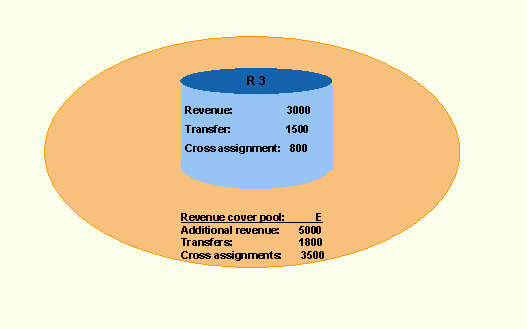
In this example, you should also transfer additional revenues manually after the actual posting to expenditures account assignment E has been completed successfully. It is also the case that the result of the budget consistency check is that sufficient transferable additional revenues are actually available for both the individual account assignment R3 and revenues cover pool R (R3: Additional revenue (3000) - Transfer (1500) results in a transferable additional revenue 1500; R: Additional revenue (5000) - Transfers (1000+300+500) results in a transferable additional revenue of 3200 for the revenues cover pool). The consequent availability control also includes the cross assignments you have saved in the check. Since cross-assignments of 3500 have already been saved in revenues cover pool R, no more additional revenues are available for further postings. The availability control refuses the posting, even though revenues account assignment R3 still has additional revenues available.
Result of check on manual budget transfer from additional revenues to R3
 ( )
( )