
 Sibling
versus Parent/Child Relationships
Sibling
versus Parent/Child Relationships

MDM supports two basic product-level relationships, as follows:
· Sibling. A sibling relationship relates a group of main table records that are equivalent and/or interchangeable from some merchandising or structural standpoint.

Sibling relationships are symmetric. In other words, if A, B, and C are in a single group of sibling records, then A is related to its siblings B and C, B is related to its siblings A and C, and C is related to its siblings A and B.
· Parent/child. A parent/child relationship relates a group of records that are not equivalent, where one of them is the parent, and the rest of them are the children.
Parent/child relationships are asymmetric. In other words, if A, B, and C are in a group of related parent/child records and A is the parent of B and C, then B is the child of A and the sibling of C, and C is the child of A and the sibling of B.
Examples of sibling relationships include “cross-sells” and “interchange products.” Examples of parent/child relationships include “assemblies and components” and “kits and parts.”
The figure below illustrates both a sibling “cross-sells” relationship and an “assemblies and components” parent/child relationship.
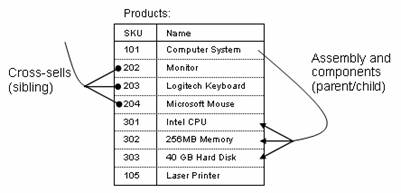
The sibling relationship itself is like a parent/child relationship without the parent, while the siblings in the sibling relationship are like the sibling children in the parent/child relationship.
A record can only belong to at most one group of related sibling records, but it can belong to multiple parent/child groups.