
 Moving a Node with Drag-and-Drop

Use
There is no explicit command to move a node from one location to another in the hierarchy tree. Instead, you can drag-and-drop a node to move it, with certain restrictions as explained below.

You can also use the Cut and Paste commands to move nodes in the hierarchy tree, as described in the section below.
When you drag-and-drop a node, a context menu automatically pops up when you drop it. The context menu prompts you to choose whether to insert the dragged node as a sibling or as a child of the target node (figure below), or alternatively, to merge the dragged node into the target node (as described in the next section).
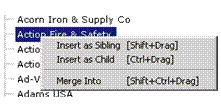
Procedure
To move a node from one location in the tree to another:
1. In the hierarchy tree, select the node you want to move.
2. Drag the selected node to the new location in the tree.
3. Choose one of the insert options from the context menu that pops up when you drop the dragged node onto the target node:
○ Insert as Sibling – inserts as a sibling just before the target
○ Insert as Child – inserts as the last child of the target
MDM removes the node from its former location and inserts it into the tree as specified by the option you chose in step 3. However, if MDM detects a condition that would result in data integrity loss if the move were completed, MDM displays a message explaining why the move is not allowed, as described in the notes below.
To bypass the pop-up context menu, hold Shift (to Insert as Sibling) or Ctrl (to Insert as Child) while you perform the drag-and-drop.
Sibling nodes in a tree cannot have the same name. When you drag-and-drop a node to move it in the tree, MDM automatically renames it to Node Name (n) if its name would be the same as that of an existing sibling node in the new location (where ‘n’ is the first available numeric value that will avoid a conflict).
When you move a category in a taxonomy tree (even in Hierarchy mode), MDM automatically detects differences in the inherited attributes in the old and new locations, and if necessary: (1) links directly to the category those attributes that were inherited but will no longer be inherited in the new location; and/or (2) unlinks from the category those attributes that were linked directly but will be inherited in the new location.
Operation |
Constraints |
Insert as Sibling |
● Must be in Hierarchy or Taxonomy mode ● Tree must have focus ● Root node cannot be moved ● Root node cannot have siblings ● Sibling nodes cannot have the same name |
Insert as Child |
● Must be in Hierarchy or Taxonomy mode ● Tree must have focus ● Root node cannot be moved ● Destination node cannot be an alias ● Destination node cannot have an alias ● Destination node cannot have a matching set ● Destination node value cannot currently be assigned to a lookup field ● Sibling nodes cannot have the same name |
For proper organization of the records within an MDM repository, a hierarchy lookup field normally be assigned only the value of a leaf node in the hierarchy table, which can sometimes prevent a tree operation that would otherwise turn a leaf node into a parent node. However, MDM does not detect if records have already been assigned to a leaf node value until after you attempt to perform the operation. As a result, the Insert as Child menu item is available even if the destination node has records assigned to it, even though this would turn it into a non-leaf node. If you choose Insert as Child in this situation, MDM does not permit the insert and instead displays an error dialog.