2.8 Navigation Area and Quick Launch 
Navigation Panel and Navigation Tabs
You can hide the navigation panel and the navigation tabs from the shell, to make more room for the content area. To do this, choose View and deselect Navigation Panel or Navigation Tabs.
 (Example of NWBC with and without navigation panel and navigation tabs)
You can open the navigation tab menu by choosing the  icon:
icon:
 (Example of navigation tab menu)
You can hide navigation tabs by choosing the  icon, which appears when you hover with the mouse cursor over the work center entry. Then the navigation tab disappears and in the work center menu,
the entry is grayed out.
icon, which appears when you hover with the mouse cursor over the work center entry. Then the navigation tab disappears and in the work center menu,
the entry is grayed out.
You can change the order of the navigation tabs as follows:
By clicking the upper left corner of a navigation tab and dragging and dropping the navigation tab
By dragging and dropping the
icon
You can scroll to reach navigation tabs that are not visible by choosing an arrow in the  icon.
icon.
You can change the icon of a navigation tab by right-clicking the navigation tab and choosing Change Icon.
Quick Launch
In addition, you can use quick navigation. This navigation is optional and can be used either as enhancement of the normal navigation or as replacement of the normal navigation (for power users). By choosing  View
View  Quick Launch
 , you can search and navigate quickly within NWBC.
Power users can search for entries within the navigation tree using a type-ahead input field. Type in a query string in the quick launch and all matches in all roles are displayed. You can now start a search in all categories that have been configured or, in case of a transaction in an ABAP system, start the transaction in the ABAP system directly. Alternatively, you can navigate to the work center listed below.
 Note
Note
You can only launch a transaction by using the quick launch if NWBC is connected against an ABAP system. For more information, see 3.4.1 Configuring Connections.
Note
In the quick launch, the search for transactions is case-sensitive. If you are not sure whether the transaction you are looking for begins with an upper case letter or not, you can skip the first letter and begin your search with the second letter. Usually, this leads to the results you require. For example, when searching for Infosatz (ME11), you could search for nfosatz instead, and the result is ME11 or Infosatz hinzufügen. In this context, note that the search in the normal navigation tree is not case-sensitive, but camel case is supported.
The quick launch is sorted in the following order:
In the first section, you can navigate directly to a URL by choosing Navigate to Web Address, if you have typed in a URL in the format www.xyz.com:
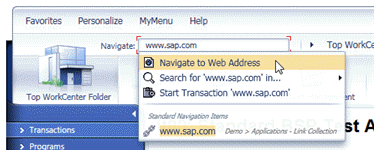 (URL example)
In the next section, you can start a search in your pre-defined search providers. Then all transactions are displayed. You can start every transaction in the ABAP system directly.
The second section shows the recently opened and favorite entries. The matches are displayed in alphabetical order. By clicking the matching item, you can open the corresponding application.
A breadcrumb-like navigation is also available. This shows the path to the actual content area and enables relative navigation at any level (click > icon to select another sibling).
 (Quick launch example in PLM with query string por)
Special Features
There are a few special features in quick launch that can help to further improve productivity:
You can use the same /n or /o sequence from SAP GUI to launch a SAP GUI transaction, for example, /oME21.
You can start a new web page directly from the quick launch by typing in the address, for example, www.sap.com or http://www.sap.com.
Within the quick launch, a normal click starts the selected application in the main window, whereas SHIFT + click opens a new window.
You can use mnemonic search against your pre-defined search providers. For more information, see 3.4.2 Configuring Search Providers.
NoteYou can only use mnemonic search against the quick launch function.
You can only configure the mnemonic search function in the frontend.
End of the note.To use the mnemonic search, in the Launch: field, enter a letter which is configured as mnenomic for a selected search engine, followed by the search string. The search is then carried out directly in the search engine configured for this letter. For example, [a] is configured as mnenomic for search on the SAP homepage (as in the example in 3.4.2 Configuring Search Providers). When you enter a in the quick launch followed by the search string, the search is carried out on the SAP homepage.
NoteUsing mnemonic search, you can also start the desktop search function. Per default, [d] is configured as mnenomic for desktop search.
End of the note.