 Configuring Data Replication
You use this function to make the necessary settings for data replication within the Data Replication Framework (DRF). Data is replicated to business systems that are assigned to outbound implementations of replication models (see graphic below).
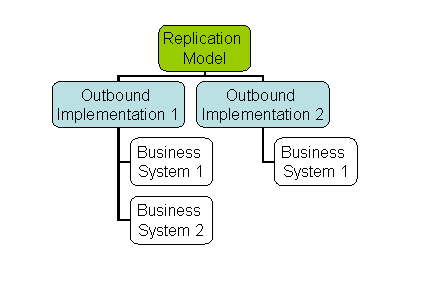
Replication Models, Outbound Implementations, and Business Systems
Features
SAP supplies most of the objects and assignments as standard, such as the following:
Business objects
Filter objects
Outbound implementations
Service operations
 Note
Note
You can view the objects and assignments that SAP supplies as standard in Customizing. More information is available in Customizing for Master Data Governance under  General Settings
  Data Replication
 .
.
However, you must configure your replication model. This involves the following:
Definition of replication model
Define your replication model and enter a description.
Definition of the receiving systems of your replication model
Enter one or more systems in which you want to replicate the data.
 Caution
When you transfer your Customizing settings to the production system, you must subsequently check and adjust the assignment of the replication model to the receiving systems.
End of the caution.Assignment of outbound implementations
You assign the desired outbound implementations to your replication model.
The outbound implementation specifies how business object data is transferred to a replication model. This means, for example, which data is to be transferred and which communication channel is to be used.
NoteThe following communication channels are available for data replication purposes:
RFC
IDoc
Enterprise Services
File download
Ensure that you use only those communication channels that are supported by your replication model.
End of the note.One or more outbound implementations can be used for each replication model. This means that different data can be transferred in different ways for a certain replication model. This depends on the attributes of the outbound implementations that are assigned to the replication model.
Definition of additional parameters per outbound implementation
You can define technical parameters for parallel processing or specify the number of business objects per bulk message, for example.
Assignment of languages
You can specify which languages the system is to take into account for language-dependent texts in the outbound implementation.
Activities
You configure your replication model in Customizing for Master Data Governance under General Settings Data Replication Define Custom Settings for Data Replication
Configure Replication Models .
For further prerequisites for data replication, see Customizing for Master Data Governance under General Settings Data Replication Overall Information .