 Pegging Logic: Not Fixed
Use
You can decide whether the assignment of replenishment elements to pegged requirements should take place according to materials requirement planning (MRP) logic or by using the Fixing Rule .
 Note
Note
Since the distribution of costs for a replenishment element is based on the pegging results that are stored in an assignment table, all the changes in the requirements display result in cost transfer postings. You should check which of the three logic types best suit your requirements and business processes.
MRP Logic
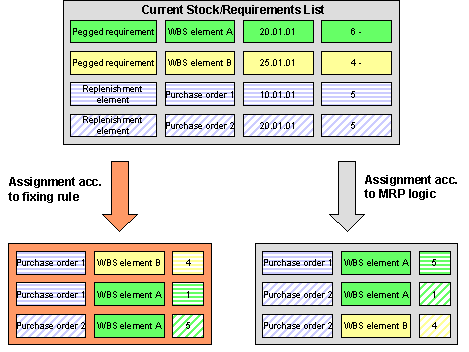
The assignments take place based on the current requirements planning situation. If changes are made to the scheduling or quantities, the assignments/pegs are also automatically changed.
Activities
The system executes the following steps when assignments are made based on MRP logic:
All open requirements and replenishment elements for a material are sorted in chronological order.
Beginning with the earliest date, the requirements and replenishment elements per material and grouping WBS element are compared and assigned.
Stock has highest priority.
Since pegging adheres to the top-down principle, based on the requirements comparison, the assignments are inherited from higher- to lower-level replenishment elements.
Example
Work breakdown structure (WBS) element A requires 6 units of a material, and WBS element B 4 units of the same material. The assignment of the replenishment elements, in this case 2 purchase orders of 5 units each, takes place as follows:
Note
You can use a Business Add-In (BAdI) to implement your own customer-specific logic to check or adjust the assignments made by the system. For more information, see Transaction Codes/BAdIs for Pegging .
See also: