 Message Processing (Advanced Adapter Engine)
This section provides information on the individual steps a message passes through at runtime within the Advanced Adapter Engine (AAE).
 Note
Note
This description applies for AAE-only message processing scenarios.
The following figure shows the processing steps.
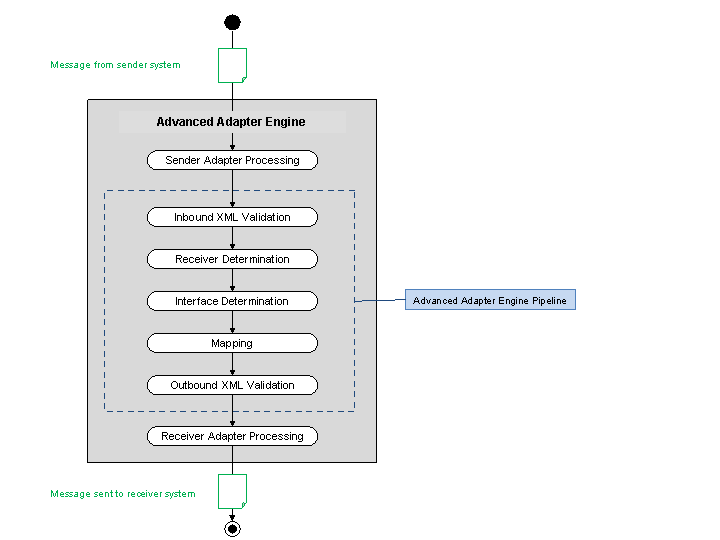
AAE-Only Message Processing (Detailed Picture)
A messages passes through the following steps:
Sender adapter processing
Based on the configuration of the sender adapter, the message is transformed technically to the XML message format the AAE can process (“XI message format”). In case also additional security-related configuration settings apply, the message is handled accordingly (for example decrypted, in case the corresponding security level is configured).
The message header matches an integrated configuration. Therefore, message processing is continued on the AAE.
Inbound XML validation
Based on the configuration settings, the inbound message is checked with regard to the validity of its XML schema.
Receiver determination
Based on the configuration settings in the integrated configuration (Receiver tab page), the receivers of the message and the routing conditions are evaluated.
In case the message should be forwarded to multiple receivers, for each receiver a separate message is created.
Interface determination
Based on the configuration settings in the integrated configuration (Receiver Interfaces tab page), the assigned inbound interfaces (at the receiver side) are evaluated.
NoteMore sophisticated scenarios can be configured where a message is sent to multiple inbound interfaces or where a large message is split into several “message chunks” which are then sent to different inbound interfaces. For sakes of simplicity we do not consider these cases here and instead of that refer to the corresponding section: Defining Message Splits.
End of the note.Mapping
Based on the configuration settings in the integrated configuration (Receiver Interfaces tab page), the assigned mapping program is performed and the content of the message transformed accordingly.
Outbound XML validation
Based on the configuration settings, the outbound message (sent to the receiver) is checked with regard to validity of its XML schema.
Receiver adapter processing
Based on the configuration of the receiver adapter (that is assigned to the integrated configuration), the message is transformed technically from the “XI message format” to the format the receiver can process. In case also additional security-related configuration settings apply, the message is handled accordingly (for example encrypted, in case the corresponding security level is configured).
Note
Note that for sake of simplicity, the figure above does not cover more sophisticated use cases like, for example, message split scenarios.
The following related section describes at which steps within the processing sequence, a message version can be saved for administrative purposes: Saving Message Versions in the AAE (Local Message Processing)