
 Java Proxies as Receiver

Use
You want to make a service available on the J2EE server. The service is to be provided by means of the Integration Server.
Integration
You must deploy the proxy beans and proxy classes generated by Java proxy generation together with the application program. To do so, include them in the same EAR file that contains the classes of your application. The generated classes are dependent on the classes of the Java proxy runtime, which must be installed on the J2EE server. To declare this dependency for EJB applications, include the following packages in the descriptor file application-j2ee-engine.xml:
com.sap.aii.proxy.xiruntime
com.sap.aii.af.sdk.xi
com.sap.xi.util.misc
com.sap.guid
All library dependencies are of type weak and have the provider name sap.com.
Prerequisites
You have created an inbound message interface for your service in the Integration Repository. Using Java proxy generation, you have created server proxy beans and server proxy classes, which you include in your application.

If you generated Java server proxies before SAP XI 3.0 FP, see SAP Note 738625.
Features
On the receiver side, the JPR proxy server listens for inbound messages from the messaging system. The JPR proxy server forwards the message to the corresponding server bean using the Java proxy runtime. This bean must be registered in the JPR registry. It calls the implementing class on the J2EE server using the generated server proxy interface (the generated classes are shown in light gray).
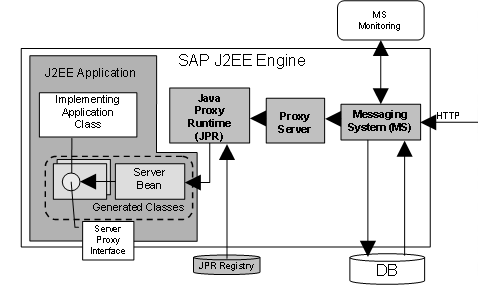
Note the following for the implementing class:
· It must implement the generated server proxy interface.
· The name of the implementing class is fixed. It comprises the name of the server proxy interface and Impl.
· The class must be derived from the class AbstractProxy.
If the message interface has the name MyInbound, then the Java interface MyInbound_PortType is generated from it that you must implement using the class MyInbound_PortTypeImpl:
public class MyInbound_PortTypeImpl
extends
AbstractProxy
implements
MyInbound_PortType {...}
To use further services of the Java proxy runtime, use the MessageSpecifier interface. For example, this interface enables you to send attachments together with the message. See: MessageSpecifier Interface.
Activities
...
1. Implement the server proxy interface.
2. Register the server proxy interface with the proxy server.