
 Message Flow to the Receiver

Use
The graphic below shows the message flow to the receiver, that is, from the Integration Server to the business system.
Features
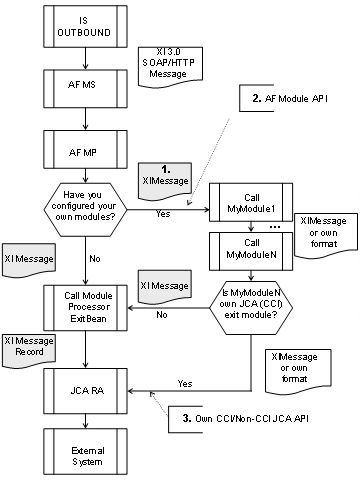
· If a message is sent from the Integration Server (IS Outbound) to the Adapter Framework, it is received by the Adapter Framework messaging service (AF MS). This service is responsible for HTTP/SOAP communication based on the XI message protocol. First, the service saves the received message.
· Then, using the data in the message header, it determines the communication channel and calls the module processor (AF MP) with the message and the communication channel ID. The message is converted to a Java object that implements the XIMessage interface.
· Depending on the adapter implementation, either the Adapter Framework standard JCA exit bean (ModuleProcessorExitBean) or your own Adapter Framework modules (MyModule1, …, MyModuleN) are called. An Adapter Framework module is defined as a stateless session Enterprise JavaBean that implements the Adapter Framework Module interface.
¡ In the first case, the ModuleProcessorExitBean determines the JCA resource adapter (JCA RA) using the ModuleProcessorExitBean module configuration of the communication channel used. It calls the JCA resource adapter using CCI (see Adapter Framework JCA CCI Library) and transfers the XI message record (a combination of a CCI record and a Java object) that implements the XI message interface.
¡ In the second case, the first Adapter Framework module (MyModule1) receives the XIMessage object with context and configuration information.
¡ The message is processed by the modules. Alternatively, the adapter can implement its own Java object instead.
¡ Finally, you must decide in the adapter implementation whether to use the Adapter Framework CCI interface to communicate with the JCA resource adapter. Alternatively, you can use your own CCI variant or a non-CCI interface. It is advisable to use the first alternative since the JCA resource adapter can be combined with other modules in this case.
· The last step is controlled by the JCA resource adapter (JCA RA). It extracts the message data from the XIMessage object (or from its own structure if it chooses a different path), maps it to the external protocol, and sends it to the corresponding application. The transactional procedure and the security settings are important here.
· In the case of asynchronous messages, you can request additional acknowledgment messages from the Integration Server. These messages show whether a message has been successfully delivered (or not). You can also display whether a message has been successfully processed by the application. If an adapter does not support acknowledgment messages, it must announce this explicitly using a method call.
Activities
The following interfaces are important for the exchange of messages in adapter development:
Das...
1. The XIMessage Java interface for message access and message creation.
2. The Adapter Framework module Java interfaces, comprising Module, ModuleContext, ModuleData, and ModuleException.
3. The Adapter Framework CCI interface, see also: Adapter Framework JCA CCI Library.

The Adapter Framework modules can be called after processing in the JCA resource adapter to process the received JCA resource adapter response before it is delivered to the Adapter Framework messaging service.