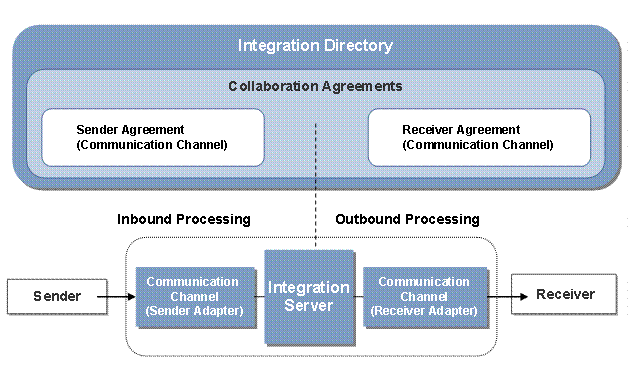
Collaboration Agreement

Use
In a collaboration agreement you define for a sender and receiver which communication channels are to be used to exchange messages.
When using the XI adapter, SOAP adapter, RNIF adapter, or CIDX adapter, the sender and receiver can also agree on additional security settings that refer to the contents of the message.
In outbound processing (see: Receiver Agreement), you can use security settings to do the following:
· Sign a message
· Guarantee the integrity of the data
In inbound processing (see: Sender Agreement), you can use security settings to do the following:
· Check the signature of an inbound message
· Check the integrity of the data
· Authorize the sender of a message
In the receiver agreements you can also set how elements of the message header are to be changed at runtime (header mapping).
Integration
The collaboration profile contains all the technical options that are available to communication parties for exchanging messages. In particular, one or more communication channels can be assigned to services and parties in the collaboration profile. In a collaboration agreement, you define which communication channel is to be used for a particular sender-receiver pair. A collaboration agreement therefore specifies the technical details for message exchange that have been agreed for a particular sender-receiver pair.
Features
Depending on the direction of message processing, define a sender or receiver collaboration agreement.
Sender and Receiver Agreement
Object Type |
Use |
Used in outbound message processing to transform a message so that it can be understood and processed by the receiver. |
|
Used in inbound message processing to transform a message so that it can be processed by the Integration Engine. |
Collaboration Agreement Objects and Runtime Procedure