 Tables


Tables
Unbounded Occurring Elements in XSD
Neither XSD nor Java has an explicit table type. However, in XSD you can define elements so that there is no limit to how often they may occur (also see:
Elements and Attributes). For example, assume you require a data type staff, which you can use to select a group of colleagues as members of staff and assign them a manager. The following table reflects the definition of this data type in the XSD editor:Definition of an Unbounded XSD Element Within a Structure
|
Structure |
Category |
Type |
Occurrence |
Description |
|
|
staff |
Complex Type |
||||
|
[-] manager |
Element |
1 |
staff manager |
||
|
name |
Element |
xsd:string |
1 |
||
|
birthday |
Element |
xsd:date |
1 |
||
|
[-] employee |
Element |
1..unbounded |
staff members |
||
|
name |
Element |
xsd:string |
1 |
||
|
birthday |
Element |
xsd:date |
1 |
||
According to this definition, the element
employee can occur more than once in the corresponding XML schema.Conversion to Java Classes
Java proxy generation generates the class
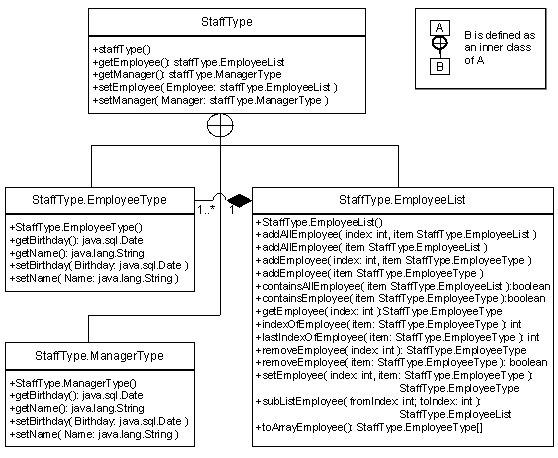
Staff_Type for the data type staff. This class can be reused just like the data type in the Integration Repository. The class provides two alternatives for accessing the values of the element employee that can occur infinitely in the message:The class
Staff_Type contains the inner class Staff_Type.Employee_List for accessing with list methods as well as the inner classes Staff_Type.Employee_Type and Staff_Type.Manager_Type.
StaffType.EmployeeList
implements the Java interface java.util.List, so that its general methods can be used (for example, the method size() determines the number of elements in the list).Class Hierarchy with Public Methods in UML Notation
Since the elements