
 Technical System Landscape
XML-based archiving involves two logically separate systems, which are generally also physically separate: The application system whose database is to be cleaned up and which contains the data to be archived, and the archiving system in which the XML Data Archiving Service is running. XML-based Archiving is available in two flavors: ABAP and JAVA.
The application system contains another important component for XML archiving, called the XML DAS Connector. If you are working with an ABAP application system the XML DAS Connector for ABAP contains the XML Archive API as well as the local archive administration, transaction SARA.
If you are working with a JAVA application system, the XML DAS Connector for JAVA currently only contains the XML Archive API for JAVA as J2EE Library. You must use the application-specific user interfaces for archiving (two JAVA XML archiving sets: XI_SEC and XI_AF_MSG). (The archiving programs of an XML archiving object use the XML Archive API for ABAP, which communicates with XML DAS using HTTP(s).)
The
XML Data Archiving Service is part of the SAP J2EE Engine, which means that
the archiving takes place on the JAVA stack of an SAP Web Application Server
for both ABAP and JAVA. The meta data and the property indexes (used for
value-based searches) are kept in the database of the J2EE Engine, while the
actual data that is archived is saved in a storage system connected via the
WebDAV protocol. Alternatively, you can also use a robust file system, which
must be made available to all servers of the SAP J2EE Engine. The file system
or rather, a part of it (folder or WebDAV collection) is used as an archive
store defined via the XML DAS Administration. Because these and other settings
are cross-application-system settings, the  XML DAS
Administration is part of the SAP J2EE Engine and must be configured for
XML data archiving for ABAP as well as JAVA.
XML DAS
Administration is part of the SAP J2EE Engine and must be configured for
XML data archiving for ABAP as well as JAVA.
The following figure shows how all of these components fit together:
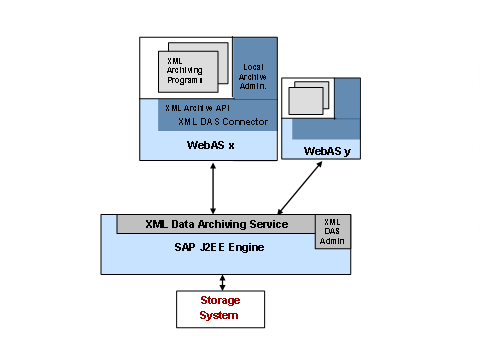
Figure 1: Relationship of the Different Components in XML-Based Archiving