
 Web
Dynpro Tools in the ABAP Workbench
Web
Dynpro Tools in the ABAP Workbench 
The Web Dynpro Explorer has been fully integrated in the ABAP Workbench and does not have a separate transaction code. In the first processing step, you use the object list selection and display an existing Web Dynpro component or create a new one:
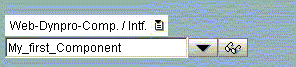
To create a new Web Dynpro component, enter a new name in the selection dialog of the object list, and select Display. In the dialog box that appears, you can enter a description of the new object and decide whether you want to create a Web Dynpro component or a Web Dynpro Component Interface.
The following sections describe in detail the tools contained in the Web Dynpro Explorer. These sections summarize all the functions of all Web Dynpro tools, so that you can access individual pieces of information as you develop a Web Dynpro application. The programming manual in this documentation contains an overview of programming with Web Dynpro.
1. Web Dynpro Explorer: Controller
2. Web Dynpro Explorer: View
3. Web Dynpro Explorer: Window
4. Web Dynpro Explorer: Component
5. Web Dynpro Explorer: Application
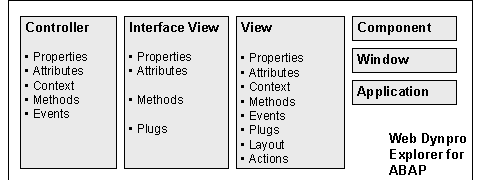
In the Web Dynpro Explorer: View (View Editor) tool, you maintain all elements of a view, that is, the elements of the respective controller and its context too.
The Web Dynpro Explorer: Controller (Controller Editor) tool, however, is used to maintain all other controllers, that is, component and interface controllers as well as any custom controllers that may have been added.
Display Interface
View
You can display the inbound and outbound plugs of an interface view
separately. The plugs are created and maintained in the Window Editor as part
of the corresponding window. In the Window Editor, in the Interface column you can determine whether a plug is
also assigned to the interface view of the window and whether it should also
be visible outside of the component.
The components of the interface controller are a subset of the component controller. They can be displayed separately for the interface controller, although its events and methods as well as its context are created and maintained in the Component Editor. Even in this case you can assign parts of the component controller selectively to the interface controller.
 You can
find platform-independent information about Web Dynpro and an introduction to
the terms that are used in general in the
You can
find platform-independent information about Web Dynpro and an introduction to
the terms that are used in general in the  Web Dynpro section
of the Architecture Manual.
Web Dynpro section
of the Architecture Manual.