
 OLAP
OLAP 
Purpose
The SAP Business Information Warehouse uses OLAP technology for the analysis of data held in the data warehouse. Online Analytical Processing (OLAP) characterizes BW as a Decision Support System. OLAP allows decision-makers to quickly and interactively analyze the multi-dimensionally modeled data appropriate to business Considerations.
InfoProviders allow this data to be viewed. As data is stored in InfoCubes optimized for the reading of data, InfoCubes and MultiProviders for InfoCubes should be the preferred InfoProvider.
Integration
The
OLAP processor, a component of the BW server, lies between the end user and
the database. It makes the multi-dimensionally formatted data available to
both the BW front end and, using special interfaces ( Open Analysis
Interfaces) to third-party administrator front-ends also. For this reason,
the OLAP processor is optimized for the analysis and reporting of very large
datasets too. End users are able to request ad hoc individual views of
business-relevant data using the Business Explorer (see BI Suite: Business
Explorer).
Open Analysis
Interfaces) to third-party administrator front-ends also. For this reason,
the OLAP processor is optimized for the analysis and reporting of very large
datasets too. End users are able to request ad hoc individual views of
business-relevant data using the Business Explorer (see BI Suite: Business
Explorer).
The following graphic displays the status and tasks of the OLAP processor within the data processing process as a multidimensional analysis is executed:
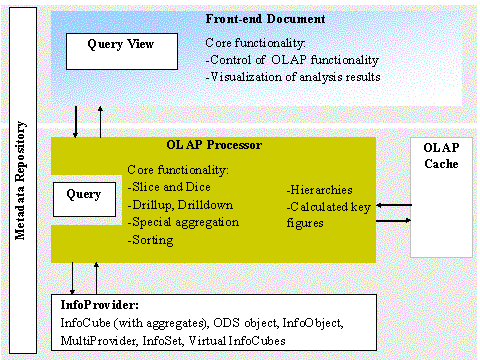
Queries are the basis of every analysis in SAP BW. To formally define a multidimensional request, a query determines:
·
the
structure – analog to a worksheet (see Structures, Defining
Restricted Key Figures, Defining Calculated
Key Figures, Defining Exception
Cells)
· the filter that affects this structure,
·
The
navigation space (free characteristics) (see Restricting
Characteristics).
SAP BW has a number of analysis and navigation functions for the formatting and valuation of a company’s data. These allow the user to formulate individual requests on the basis of multi-dimensionally modeled datasets (InfoProviders). Subsequently the user is able to view and evaluate this data from different perspectives during the runtime. The overall functionality for retrieving, processing and formatting this data is provided by the OLAP processor.
Features
The following table offers an overview of the OLAP functions and services implemented in the Business Information Warehouse.

You can find more information about this under Special OLAP
Functions and Services, Performance-Optimization
and in the section BI Suite: Business
Explorer.
OLAP functions and services in overview
OLAP Function |
Operations in Detail |
Navigation |
· Drilldown to characteristic / structure element. Remove element drilldown from the view (dice) · Expand (drilldown) and hide (drill up) hierarchy nodes · Exchange drilldown elements (swap) |
Filters |
· Restrict (slice) characteristics to selections (single value, value range, hierarchy element, exclusion) |
Aggregation |
· Standard aggregation: Default, key figure-dependant calculation formula for the aggregation of single result values · Exception aggregation: Special aggregation setting in relation to a particular characteristic. For example, aggregation average of account balance with reference to the characteristic ‘time’ · Local aggregation or local calculation: (for example, the calculation of individual values displayed for normalizing from the overall result) |
Layout |
· Layout of the characteristics as key / description · Display / suppress results rows · Change position of hierarchy nodes (up / down) |
Result-dependant selection and layout |
· Threshold Values (Exceptions): Highlighting of uncommon variance in key figure values in · Conditions: Key figure-dependent restriction of characteristics according to defined conditions |
Structuring |
· Hierarchical assignment of characteristic values with drill down for more than one element (‘Universal Display Hierarchy’) |
Generic and business analysis functions |
· Sorting regarding characteristics and key figures · Calculated key figures and formulas (enables statistical and mathematical calculation on the basis of key figure values · Currency translation · Elimination of internal business volume: (business elimination of internal transactions) |
Concepts for optimizing runtime |
· Non-cumulatives · Aggregates · OLAP Cache (adjustable in the cache mode, dependent on query) |
Integrated additional functions |
· Variables for parameterization and increased reusability of queries · Report-report interfaces for navigation in different reports · Authorization concept for controlling user authorizations with reference to accessing data |