
 Reference Characteristics and the Configuration Engine

Use
You can use reference characteristics when configuring products with the Configuration Engine to copy certain values from the application or transfer values to the application automatically.In other words, these reference characteristics can be defined as containers for exchanging values between the Configuration Engine and the application (context). This is possible because reference characteristics refer to table fields in the application. When products are configured, the Configuration Engine takes these references into account and can read values from or write values to the table fields.
There are other additional reference characteristics that control whether a characteristic is visible or ready for input, depending on the interactive configuration process. The Configuration Engine takes the references of these reference characteristics into account in connection with the dependency rules – which indicate, for example, that a characteristic is to be invisible during interactive configuration if a particular combination of assigned values occurs.
Integration
When using reference characteristics, it is important to know what options the respective context offers. This mainly applies to modeling: If, for example, you create a model with reference characteristics in mySAP ERP and want to use this model with the Configuration Engine in a different environment, you must take into account which context parameters are actually available within this environment and how these parameters can be used with the Configuration Engine.
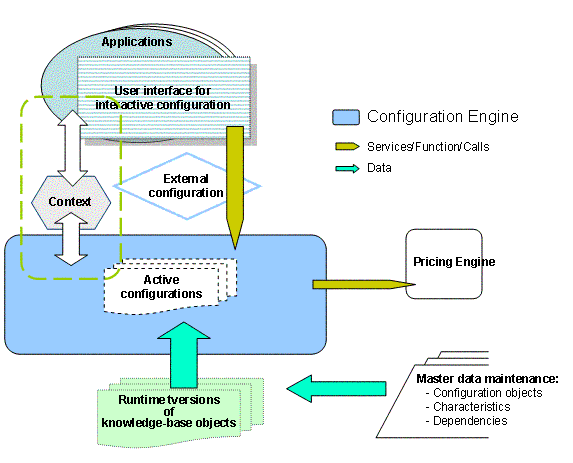
For information about the availability and use of each context parameter in the respective environments, see the documentation for the application involved.
Prerequisites
· You have created one or more reference characteristics in your model.
· You have taken into account the options within the context.
· The reference characteristics refer to the root instance of the model only.
Features
For production configuration with the Configuration Engine, you can use three types of reference characteristics; read context parameters, write field contents, and reference characteristics that control the user interface.
Write Reference Characteristics
You can transfer values from the configuration to the application using reference characteristics with write access to table fields. These types of reference characteristics refer to:
· Table STPO and field MENGE for transferring the item quantity
· Table SDCOM and field VKOND for transferring variant-dependent surcharges or discounts on prices.
Control Reference Characteristics
Certain reference characteristics allow you to control the user interface during configuration; this includes the visibility and ready-for-input status of characteristics. These reference characteristics refer to the table SCREEN_DEP and the fields:
· INVISIBLE for controlling the visibility of characteristics
· NO_INPUT for controlling the ready-for-input status of characteristics
Context-Related Reference Characteristics
During configuration, you can include the following information from the application using reference characteristics with read access to the environment parameters:
· Document properties – for example, order number, sold-to party, or sales document
· Item attributes – for example, material number, base unit of measure, or item category
· Product characteristics – for example, short texts from a sales order item, delivering plant, or in-house production time
· Business data from sales documents – for example, date for pricing and the exchange rate.
Identification of Context Parameters
If you want to define a reference characteristic, you have to create the reference using the table name and the table field name. The Configuration Engine identifies context parameters in the form table name-table field name, for example, VBAK-AUFNR, to import the order number. For the names of the available context parameters, see the list below.
You can define additional context parameters that the Configuration Engine identifies in the form described. Within the application, you must use these additional context parameters with the help of appropriate enhancements (BAdIs). For descriptions of these enhancements, see the documentation for the respective application.
You can name reference characteristics, as required. For this reason, the reference characteristic names listed below are merely examples.
Context Parameters of Document Properties
Table |
Field |
Reference Characteristic |
Data Type |
Description |
BUT000 |
PARTNER |
DOCUMENT_SOLD_TO_PARTY_CRM |
CHAR10 |
Sold-to party in CRM |
CRMD_ORGMAN |
SALES_ORG |
DOCUMENT_SALES_ORG_CRM |
CHAR14 |
Sales organization in CRM |
VBAK |
ANGDT |
DOCUMENT_VALID_FROM |
DATS8 |
Quotation/inquiry valid from |
VBAK |
AUART |
DOCUMENT_TYPE |
CHAR4 |
Sales document type |
VBAK |
AUFNR |
DOCUMENT_ORDER_NUMBER |
CHAR12 |
Order number |
VBAK |
AWAHR |
DOCUMENT_SALES_PROBABILITY |
NUMC3 |
Sales probability |
VBAK |
ERDAT |
DOCUMENT_CREATION_DATE |
DATS8 |
Date on which document was created |
VBAK |
KALSM |
DOCUMENT_PRICING_PROCEDURE |
CHAR6 |
Pricing procedure |
VBAK |
KUNNR |
DOCUMENT_SOLD_TO_PARTY_R3 |
CHAR10 |
Sold-to party |
VBAK |
LIFSK |
DOCUMENT_DELIVERY_BLOCK |
CHAR2 |
Delivery block (document header) |
VBAK |
SPART |
DOCUMENT_DIVISION |
CHAR2 |
Division |
VBAK |
VBELN |
DOCUMENT_ID |
CHAR10 |
Sales document |
VBAK |
VBTYP |
DOCUMENT_CATEGORY_R3 |
CHAR1 |
Sales document category |
VBAK |
VKORG |
DOCUMENT_SALES_ORG_R3 |
CHAR4 |
Sales organization |
VBAK |
VTWEG |
DOCUMENT_DISTRIBUTION_CHANNEL |
CHAR2 |
Distribution channel |
Context Parameters for Attributes of Order Items
Table |
Field |
Reference Characteristic |
Data Type |
Description |
BUT000 |
AG |
ITEM_SOLD_TO_PARTY_CRM |
CHAR10 |
Sold-to party in CRM |
BUT000 |
WE |
ITEM_GOODS_RECIPIENT_CRM |
CHAR10 |
Goods recipient in CRM |
CRMD_ORDERADM_I |
PMATN |
ITEM_PRICING_PRODUCT_ID_CRM |
CHAR40 |
Pricing product in CRM |
VBAP |
ARKTX |
ITEM_DESCRIPTION |
CHAR40 |
Short text for item |
VBAP |
AWAHR |
ITEM_SALES_PROBABILITY |
NUMC3 |
Order probability of item |
VBAP |
BRGEW |
ITEM_GROSS_WEIGHT |
QUAN15 |
Gross weight of item |
VBAP |
ERDAT |
ITEM_CREATION_DATE |
DATS8 |
Date on which record was created |
VBAP |
GEWEI |
ITEM_WEIGHT_UNIT |
UNIT3 |
Weight unit |
VBAP |
KWMENG |
ITEM_TOTAL_QUANTITY |
QUAN15 |
Cumulative order quantity is sales units |
VBAP |
MATNR |
ITEM_PRODUCT_ID_R3 |
CHAR18 |
Material number |
VBAP |
MATWA |
ITEM_SELECTED_PRODUCT |
CHAR54 |
Material/product ID entered |
VBAP |
MEINS |
ITEM_BASE_UNIT |
UNIT3 |
Base unit of measurement |
VBAP |
MVGR1 |
ITEM_PRODUCT_GROUP1 |
CHAR3 |
Product group 1 |
VBAP |
MVGR2 |
ITEM_PRODUCT_GROUP 2 |
CHAR3 |
Product group 2 |
VBAP |
MVGR3 |
ITEM_PRODUCT_GROUP3 |
CHAR3 |
Product group 3 |
VBAP |
MVGR4 |
ITEM_PRODUCT_GROUP4 |
CHAR3 |
Product group 4 |
VBAP |
MVGR5 |
ITEM_PRODUCT_GROUP5 |
CHAR3 |
Product group 5 |
VBAP |
NTGEW |
ITEM_NET_WEIGHT |
QUAN15 |
Net weight of item |
VBAP |
PMATN |
ITEM_PRICING_PRODUCT_ID_R3 |
CHAR18 |
Pricing reference material |
VBAP |
PSTYV |
ITEM_CATEGORY |
CHAR4 |
Sales document item category |
VBAP |
UMVKN |
ITEM_SALES_TO_SHIP_UNIT_DENOM |
DEC5 |
Denominator (divisor) for conversion of sales quantity into SKU |
VBAP |
UMVKZ |
ITEM_SALES_TO_SHIP_UNIT_NUMER |
DEC5 |
Numerator (factor) for conversion of sales quantity into SKU |
VBAP |
VBELN |
ITEM_DOCUMENT_ID |
CHAR10 |
Sales document for item |
VBAP |
VOLEH |
ITEM_VOLUME_UNIT |
UNIT3 |
Volume unit |
VBAP |
VOLUM |
ITEM_VOLUME |
QUAN15 |
Volume of item |
VBAP |
VRKME |
ITEM_SALES_UNIT |
UNIT3 |
Sales unit |
VBPA_AG |
KUNNR |
ITEM_SOLD_TO_PARTY_R3 |
CHAR10 |
Sold-to party |
VBPA_AG |
LAND1 |
ITEM_SOLD_TO_COUNTRY |
CHAR3 |
Country of sold-to party |
VBPA_RE |
KUNNR |
ITEM_BILLED_TO_PARTY_R3 |
CHAR10 |
Bill-to party |
VBPA_RE |
LAND1 |
ITEM_BILLED_TO_COUNTRY |
CHAR3 |
Country of bill-to party |
VBPA_RG |
KUNNR |
ITEM_PAYER_R3 |
CHAR10 |
Payer |
VBPA_RG |
LAND1 |
ITEM_PAYER_COUNTRY |
CHAR3 |
Country of payer |
VBPA_WE |
KUNNR |
ITEM_GOODS_RECIPIENT_R3 |
CHAR10 |
Goods recipient |
VBPA_WE |
LAND1 |
ITEM_GOODS_RECIPIENT_COUNTRY |
CHAR3 |
Country of goods recipient |
Context Parameters for Properties of Material Master Sales View
Table |
Field |
Object Characteristic |
Data Type |
Description |
COMM_PRODUCT |
PRODUCT_ID |
PRODUCT_ID_CRM |
CHAR40 |
Product ID |
MAAPV |
ARKTX |
PRODUCT_DESCRIPTION |
CHAR40 |
Short text for sales order item |
MAAPV |
BRGEW |
PRODUCT_GROSS_WEIGHT |
QUAN13 |
Gross weight |
MAAPV |
DWERK |
PRODUCT_DELIVERY_PLANT |
CHAR4 |
Delivering plant |
MAAPV |
GEWEI |
PRODUCT_WEIGHT_UNIT |
UNIT3 |
Weight unit |
MAAPV |
MATNR |
PRODUCT_ID_R3 |
CHAR18 |
Material number |
MAAPV |
MTART |
PRODUCT_TYPE_R3 |
CHAR4 |
Material type |
MAAPV |
NTGEW |
PRODUCT_NET_WEIGHT |
QUAN13 |
Net weight |
MAAPV |
PMATN |
PRODUCT_PRICING_ID_R3 |
CHAR18 |
Pricing reference material (default) |
MAAPV |
VOLEH |
PRODUCT_VOLUME_UNIT |
UNIT3 |
Volume unit |
MAAPV |
VOLUM |
PRODUCT_VOLUME |
QUAN13 |
Volume |
MAEPV |
DZEIT |
PRODUCT_MANUFACTURING_TIME |
DEC3 |
In-house production time |
MAEPV |
MATNR |
COPY_1_OF_PRODUCT_ID_R3 |
CHAR18 |
Material number |
MAEPV |
STDPD |
PRODUCT_VARIANT_OF_R3 |
CHAR18 |
Configurable material for variant |
MAEPV |
WZEIT |
PRODUCT_REPLENISHMENT_TIME |
DEC3 |
Total replenishment lead time (in workdays) |
Context Parameters for Business Data in Sales Documents
Table |
Field |
Reference Characteristic |
Data Type |
Description |
VBKD |
PRSDT |
ITEM_PRICING_DATE |
DATS8 |
Date for pricing and exchange rate |
VBKD |
ZTERM |
ITEM_TERMS_OF_PAYMENT |
CHAR4 |
Terms of payment key |