 Business Transaction Customizing
This section provides information about the model of SAP CRM business transactions, which is the basis for business transaction Customizing. You define business transactions in Customizing for Customer Relationship Management
under 
Transactions

Basic Settings
 . For information about where the individual elements are defined, see “Overview of Transaction Customizing” below.
Transaction Types
Transaction types define the characteristics and attributes of a business transaction (for example, whether it is a sales order, service request, or sales call), and determine how the transaction is processed (for example, profiles and procedures used to determine texts, business partners, statuses, and organizational data).
Assignment of Business Transaction Categories
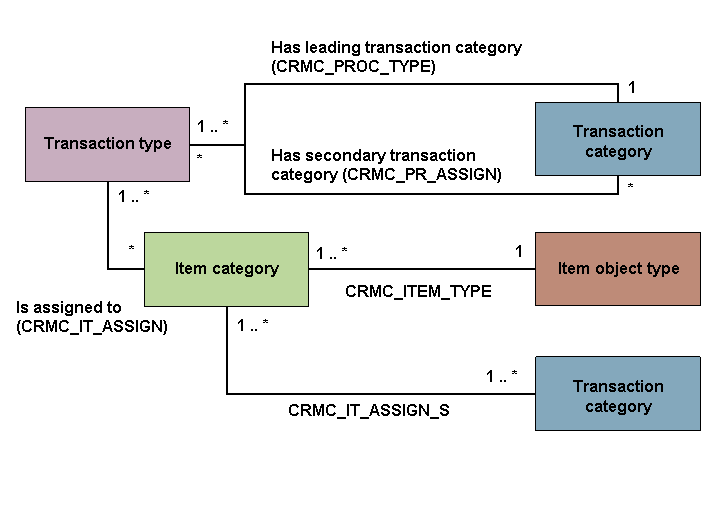
You assign a transaction type to one or more business transaction categories. Only specific combinations of business transaction categories are allowed. In addition to the general settings for a transaction type, you need to make Customizing settings specifically for each business transaction category assigned to a transaction type.
In the definition of the transaction type, you define one business transaction category as the leading business transaction category. This indicates that the transaction category has the greatest relevance for the transaction type (and not that the category is related hierarchically to the categories).
 Example
A sales order with business activity data, for example, has Sales
as a leading transaction category, but also has the transaction category Business Activity
assigned. The transaction is considered a sales transaction rather than
as an activity for the purpose of processing on the user interface.
The leading transaction category of a transaction type determines which Customizing options are available for this transaction type, such as which item categories can belong to the transaction type or which further transaction categories can be assigned. The assigned transaction categories define which additional functionality is available for this transaction type (for example, whether it can be used in sales processes).
The assigned transaction category can be the same category as the leading transaction category, if additional Customizing is required for the leading transaction category.
Assignment of Item Categories
You specify the default item category for a transaction type, and you can also define alternative item categories that are allowed for a transaction type.
Item Categories
Item categories define the characteristics and attributes of a transaction item (for example, whether it is a sales item, service material item, or activity item), and determine how the item is processed (for example, profiles and procedures used to determine texts, business partners, statuses, and organizational data).
Assignment of Business Transaction Categories
An item category is assigned to one or more business transaction categories (see “Business Transaction Categories” below). Only specific combinations of business transaction categories are allowed. In addition to the general settings for each item category, you need to make Customizing settings specifically for each business transaction category assigned to an item category.
Assignment of Item Object Type
Each item category is assigned an item object type, which defines the context in which the item can be used (for example sales or service processes). This context is defined by the transaction categories that are assigned to the item.
Business Transaction Categories
Business transaction categories are defined by SAP and correspond to business object types in the business object repository, for example, Sales
(BUS200115
), Service Process
(BUS200116
), Business
Activity
(BUS200126
).
A business transaction category determines the business context in which a business transaction or item can be used. It determines the following:
The maximum allowed structure of a certain type of transaction
The objects of which the transaction category consists
Secondary transaction categories with which the transaction category can be combined
The item object types of which the transaction category consists, and hence the objects of which the item object type consists
Overview of Transaction Customizing
The following table shows the Customizing activities and corresponding tables in which the elements of business transactions are defined. All activities are in Customizing for Customer Relationship Management
under Transactions
Basic Settings
.
Element |
Customizing |
Table |
Note |
|---|---|---|---|
Transaction type |
|
|
The leading transaction category is also specified in this table. |
Secondary transaction categories for transaction type |
|
|
The allowed transaction categories are predefined by SAP. |
Item category |
|
|
The item object type is also defined in this table. |
Item categories belonging to transaction type |
|
|
Not applicable |
Transaction categories for item categories |
|
|
The allowed transaction categories are predefined by SAP. |
The elements of business transaction Customizing described above is shown in the following figure:
Example
The following figure shows how the Standard Order
transaction type is modeled, and is followed by an explanation:

The transaction type Standard Order
(TA
) has the leading transaction category Sales
(BUS2000115
)and one secondary transaction category, namely Business
Activity
(BUS2000126
). It can consist of several item categories such as the Sales Item
(TAN
) or the Sales Configuration Item
(TAC
).
Both item categories have item object type Sales Item
(BUS2000131
) and are assigned to transaction category Sales
(BUS2000115
).
More Information
For information about the business transaction elements that are predefined by SAP, see Business Transaction Model.