Business Transaction Subobjects
Business transaction subobjects encapsulate functions, such as status handling, that can be reused by several transactions. These subobjects are defined by SAP in the table CRMC_OBJECTS
. The object name (name of the subobject) is used by the services such as the
link handler and the event handler (see Event Handler and Callback Registration), to identify the initiator.
The following types of subobject are available:
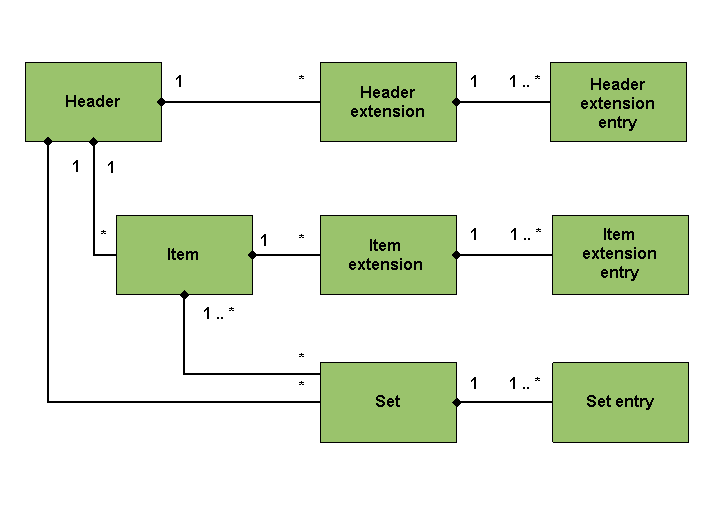
Header and item
Each transaction consists of at least one header. Several items can be linked to this header.
Header and item extension
Extensions store additional data belonging either to the header or item. Extensions are, therefore, either header extensions or item extensions. Extensions can have multiple entries.
Set
Sets store additional data that can belong to a header and/or item. Each set can have multiple entries, assigned to the header or item by a link. A single entry can be assigned to the both the header and/or multiple items by a link. Typically, sets are assigned to both header and item, and the values are inherited from header to item.
 Example
The partners in a business transaction are modelled as a set on header and item level. By default the partners are inherited to the items, however, you can also change the partner data on item level.
End of the example.
The relationship model between subobject types, as described above, is depicted in the following figure: