
 Recursive Context Nodes
In some applications, it may be necessary to display recursive data in the context. A simple example for the use of recursive data is the file system of an operating system. It consists of folders and files, and each folder can contain further folders and files. When defining controller contexts, it should be possible to display such recursive data structures.
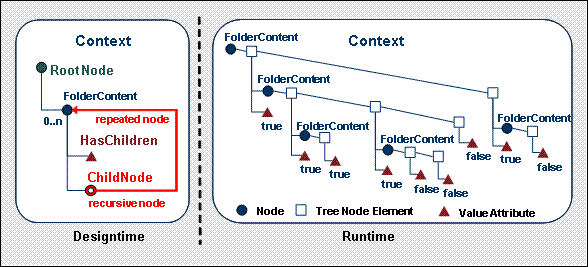
In Web Dynpro, this is implemented as follows. Under the parent node, you insert a special context node, a recursive node. You then assign this node the property repeated node. The value of this property corresponds to the higher-level context node that is to be repeated. At runtime, a recursive node is automatically of the non-singleton type and therefore exists exactly once for each parent node element.
To display a directory structure using the tree UI element, the following context structure is defined in the example: At design time, a FolderContent node is created that can represent both a folder and a document. Using the context attribute HasChildren, you can specify whether the node element represents a folder (HasChildren: true) or a file (HasChildren: false). Therefore, the context has the following structure at design time or runtime:
Next step:
Further Procedure for Creating the Web Dynpro Tree